
The Day Buffett Retires: End of an Era or Just Another Tuesday for Berkshire Hathaway?
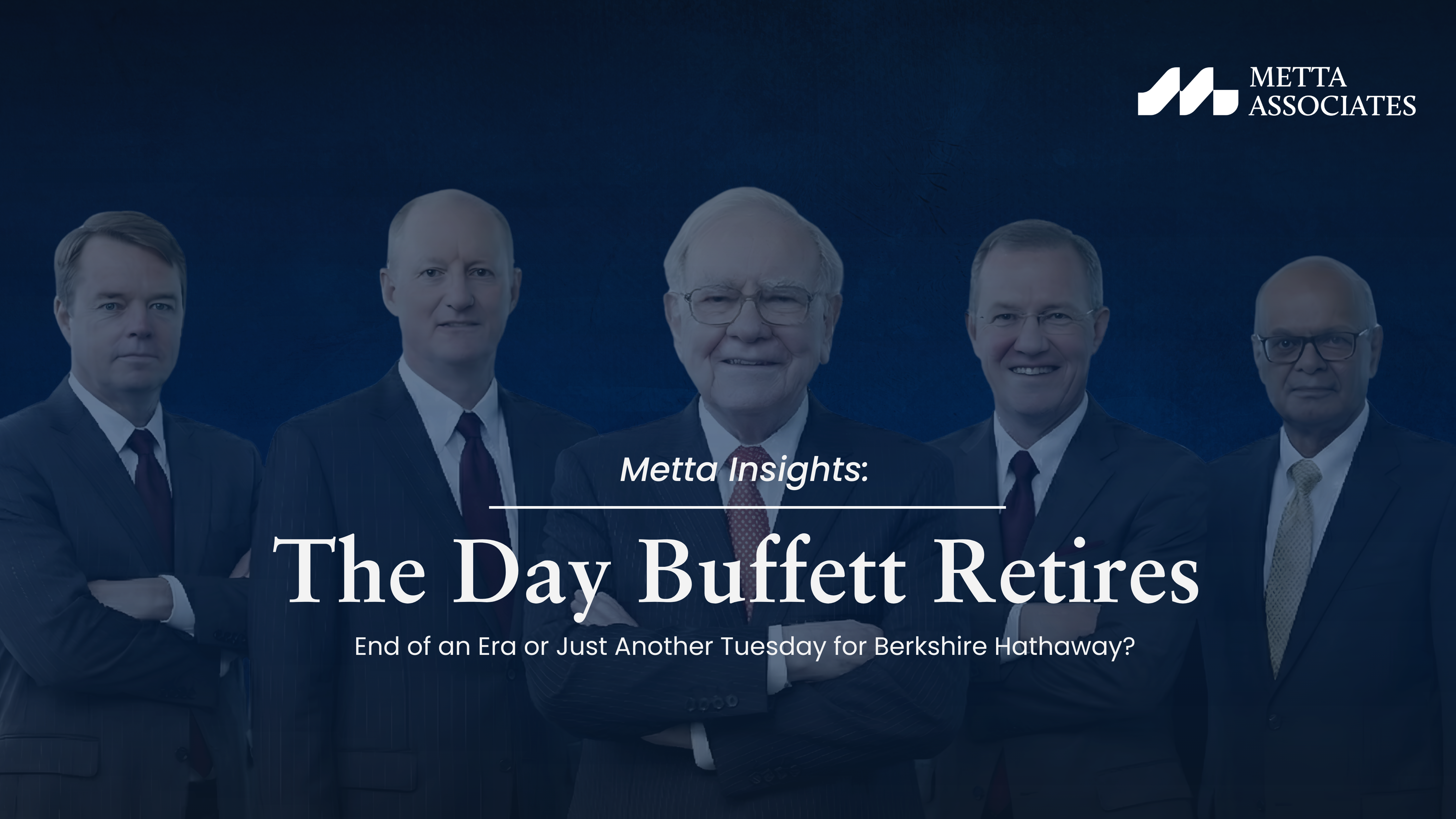
It is the inevitable question every Berkshire Hathaway shareholder must eventually face: What happens when the Oracle of Omaha is gone? For decades, investors have arguably paid a "Buffett Premium"—a higher share price driven by unwavering faith in Warren Buffett’s singular genius.
The concern is natural, but it stems from a misunderstanding of the company's current state. The transition away from Buffett isn't an approaching crisis; it is a project that has been actively engineered for over a decade. We are not staring at a sudden cliff, but rather walking across a bridge that was completed years ago.
The 20-Year Blueprint: A Strategy, Not a Coincidence
The most compelling evidence that this transition is far from a leadership vacuum lies in Warren Buffett’s consistent vision. A review of the 2006 Shareholder Letter—written nearly two decades ago—reveals that Buffett had already identified his successor and formally communicated this choice to the Board of Directors. This demonstrates that preparation for a "post-Buffett" era is not a reactive measure, but a deliberate, long-term process meticulously refined over decades.
The culmination of this long-term planning is the elevation of Greg Abel as the designated future CEO. Far from being an outsider, Abel is a veteran commander who has been leading Berkshire Hathaway’s core forces for years:
- Commander of Non-Insurance Operations: Since 2018, Greg Abel has served as Vice Chair overseeing all Non-Insurance Operations. This portfolio covers over 90 subsidiaries. His role extends beyond mere administration; he stewards the empire’s primary revenue engines, ranging from the BNSF railway and Berkshire Hathaway Energy (BHE) to vast retail and manufacturing holdings.
- Proven in the Field: Abel is not an executive recently parachuted in; he has been with Berkshire Hathaway since 2000, following the acquisition of MidAmerican Energy. He climbed the ranks by driving growth in the energy sector, earning the highest level of trust. Buffett himself famously remarked, "He does all the work and I take all the bows," a testament to the reality that Abel has practically been managing a significant portion of the Berkshire Hathaway empire for years.
- Cultural Continuity: The selection of Abel rests not only on his capital allocation skills but also on his deep internalization of Berkshire Hathaway’s unique culture, particularly its philosophy of decentralization. Having worked alongside Buffett for over two decades, this succession is akin to a practiced baton hand-off in a relay race, rather than offloading a burden to a newcomer unfamiliar with the company’s spirit.
Therefore, what investors are facing is not the "risk" of change, but the "stability" of a matured strategy. This transition is designed to ensure Berkshire Hathaway continues to thrive, powered by a system that Greg Abel himself helped build and nurture.
The Power of Decentralization: Autonomous Leaders in Action
Ajit Jain: The Architect of Risk
While Greg Abel leads the non-insurance businesses , Ajit Jain is the key figure behind Berkshire Hathaway's insurance operations. He is essential to the company's financial stability. Ajit uses advanced mathematics and market analysis to manage risk effectively.
- The Insurer of Last Resort: Unlike competitors who avoid volatile "Super-Catastrophe" risks (such as major hurricanes) due to fear of bankruptcy, Ajit is willing to accept them—but only when the math proves the long-term profit is worth it. Backed by massive capital, this makes Berkshire Hathaway the only company capable of providing coverage during major crises when no one else can.
- Decision-Making Authority: Ajit has the power to approve multi-billion dollar deals by himself. He does not need to wait for a committee's approval. This speed gives Berkshire Hathaway a major advantage when clients need an immediate answer.
- Generating Investment Capital: Ajit is an expert at identifying "mispriced" risks—situations where the premium collected is higher than the actual statistical risk. By accepting these deals, he gathers large amounts of cash upfront, known as "float." Since claims are often paid many years later (or sometimes never), this money acts like a massive interest-free loan. Warren Buffett then uses this "free capital" to buy stocks and acquire businesses, effectively fueling the company's growth with other people's money.
Ajit Jain’s ability to manage global risks with full authority demonstrates that Berkshire Hathaway does not depend solely on Warren Buffett. The company is built on a culture of decentralization. This allows skilled leaders like Ajit to operate effectively and support the company independently.
Todd Combs & Ted Weschler: The Next-Gen Investors
To answer the pressing question, "Who will pick the stocks when Buffett is gone?" We must first challenge the common misconception that Warren Buffett is the sole decision-maker. In reality, Todd Combs and Ted Weschler already operate with distinct independence, serving as the quiet engines behind Berkshire Hathaway’s modern portfolio.
- Stewards of Capital: Together, they manage multi-billion dollar portfolios (estimated at $15–17 billion each) with "Full Autonomy." Contrary to the traditional view of a "One-Man Show," they do not require Buffett's permission to execute trades. In fact, Buffett often learns of their specific stock picks only upon reviewing the monthly portfolio reports, a testament to the absolute trust placed in their judgment.
- Evolution of Value: Their influence extends far beyond merely picking stocks; they are reshaping Berkshire Hathaway’s investment perspective. A prime example is Apple. While Buffett historically avoided the technology sector because it fell outside his "circle of competence," it was the fresh insight of his lieutenants that reframed the narrative. They viewed Apple not just as a complex tech firm, but as a powerful "Consumer Goods" franchise with an indispensable ecosystem. This pivotal mindset shift paved the way for Apple to become Berkshire Hathaway’s largest holding, ensuring that the firm’s capital allocation vision remains sharp, adaptable, and relevant in the modern economy.
By blending traditional discipline with a modern lens, Todd and Ted serve as the perfect complement to Buffett’s legacy. They are the definitive answer to why Berkshire Hathaway remains a formidable force, ready to navigate the future with or without the Oracle’s direct hand.
The Numbers: How Berkshire Hathaway Generates More Value with Less ‘Pain’
The story of leadership succession and prudent risk management is not just an abstract concept; it is clearly reflected in the actual investment results.
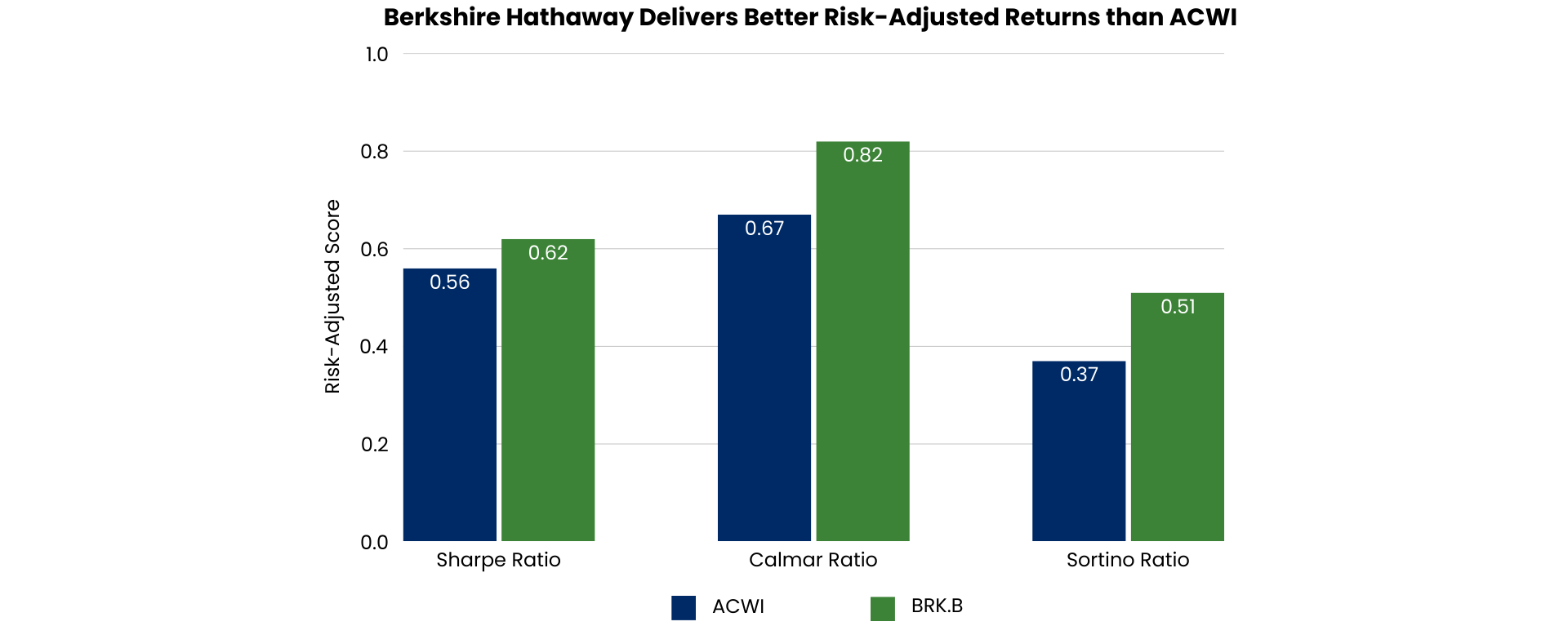
To see the full picture, we shouldn't just ask 'Who made more money?' Instead, let's compare Berkshire Hathaway (BRK.B) against the global market (ACWI) through the lens of 'Return Quality'—specifically, how well the company manages risk to deliver value to shareholders.
Sources: Yahoo Finance, Metta Associates.
Data from ETFs: ACWI, BRK-B.
Berkshire Hathaway outperforms the global market across every key risk-adjusted ratio. The higher Sharpe Ratio demonstrates efficient growth, while the dominant Calmar and Sortino Ratios highlight its superior downside protection. These metrics prove that Berkshire excels at defending capital during market dips. Essentially, investors receive high-quality returns with significantly less exposure to volatility compared to the broader index.
These numbers prove that investors aren't just holding a stock that grows; they are holding an asset built to withstand storms. This stability is the foundation that allows the company to thrive long-term, no matter who sits in the CEO's chair.
Key Takeaways:
- A Crisis Averted by a 20-Year Blueprint The transition is not a sudden emergency but a project meticulously engineered over decades. Warren Buffett identified his successor and formally communicated this choice to the Board as early as the 2006 Shareholder Letter2. Therefore, investors are not facing the "risk" of abrupt change, but rather the stability of a fully matured strategy.
- Continuity Through Proven Execution Greg Abel is not an outsider stepping in; he is a veteran commander who has been leading Berkshire Hathaway’s core forces for years. Since 2018, he has served as Vice Chair overseeing all Non-Insurance Operations, a portfolio covering over 90 subsidiaries 4. As Buffett famously noted, "He does all the work and I take all the bows"—confirmation that the business is already in capable hands.
- Culture as the True Stabilizer The company's resilience rests not on one person, but on a unique culture of trust and decentralization. The selection of Abel is based on his deep internalization of this philosophy over two decades. This succession is akin to a practiced baton hand-off in a relay race, ensuring the company's spirit and operational freedom remain intact.
Sources: Morningstar, Berkshirehathaway, The Wall Street Journal, Straitstimes.
Metta Associates's Strategic Reflection
Berkshire Hathaway serves as a reminder that enduring success rests on a strong foundation, not just on one leader.
While the market often worries about leadership changes, we see a strong foundation that has been established for over two decades. The transition to the Greg Abel era is like a well-rehearsed baton pass in a relay race, not handing a burden to a novice.
We believe in investments driven by a culture of decentralization. This is why we continue to view Berkshire Hathaway as an asset that "hurts less" during market volatility and as a vital component of a portfolio focused on sustainability, rather than speculation on a single person—always with you.
Disclaimer
The information presented is based on sources believed to be reliable; however, its accuracy or completeness cannot be guaranteed. This material does not represent a forecast and should not be interpreted as a guarantee of future outcomes. It has been prepared with care and objectivity to support long-term, planning-focused financial decisions.