
Outlook 2026: The Great Realignment and Navigating Shifting Global Forces

The year 2025 represented a pivotal inflection point for the global economy, marking a systemic departure from a framework centered on cost efficiency toward a new paradigm anchored in national security and strategic resilience.1 2 3 This fundamental structural realignment was propelled by three defining catalysts.
A New Trade Order
Liberation Day marked a significant shift as the U.S. imposed the largest tariff hikes in a century.4 5 This spike in import costs pushed companies to order goods earlier than usual to avoid higher tariffs, leading to a sharp squeeze on retail margins.6 7 Consequently, companies pivoted from low-cost sourcing toward near-shoring and resilient supply chains, prioritizing national security and operational stability over mere price efficiency.8 9 10
Fiscal Turbulence and the Information Vacuum
Fiscal tensions peaked with a record-breaking 43-day U.S. government shutdown as public debt surged past the nation's total economic output.11 12 13 14 With limited official data available, investors were left in the dark, fueling sharp market swings.15 16 This uncertainty quickly spilled into the bond market, where investors began to question the government's ability to manage its growing debt.17 18 19 As confidence weakened, bonds were sold off aggressively, pushing yields higher as investors demanded greater compensation for holding government debt that now appeared increasingly large relative to the country's income and long-term fiscal stability.20 21
The AI Revolution
2025 saw capital flood into physical AI as tech titans deployed unprecedented investment to move AI into tangible infrastructure, which includes data centers.22 This expansion pushed electricity demand to nearly double existing production capacity.23 24 The shift triggered a massive sector rotation. Capital migrated from traditional software companies that struggled to monetize toward energy and utilities. These sectors have emerged as the new backbone of the economy, essential for supporting a power- hungry AI future.25 26 27
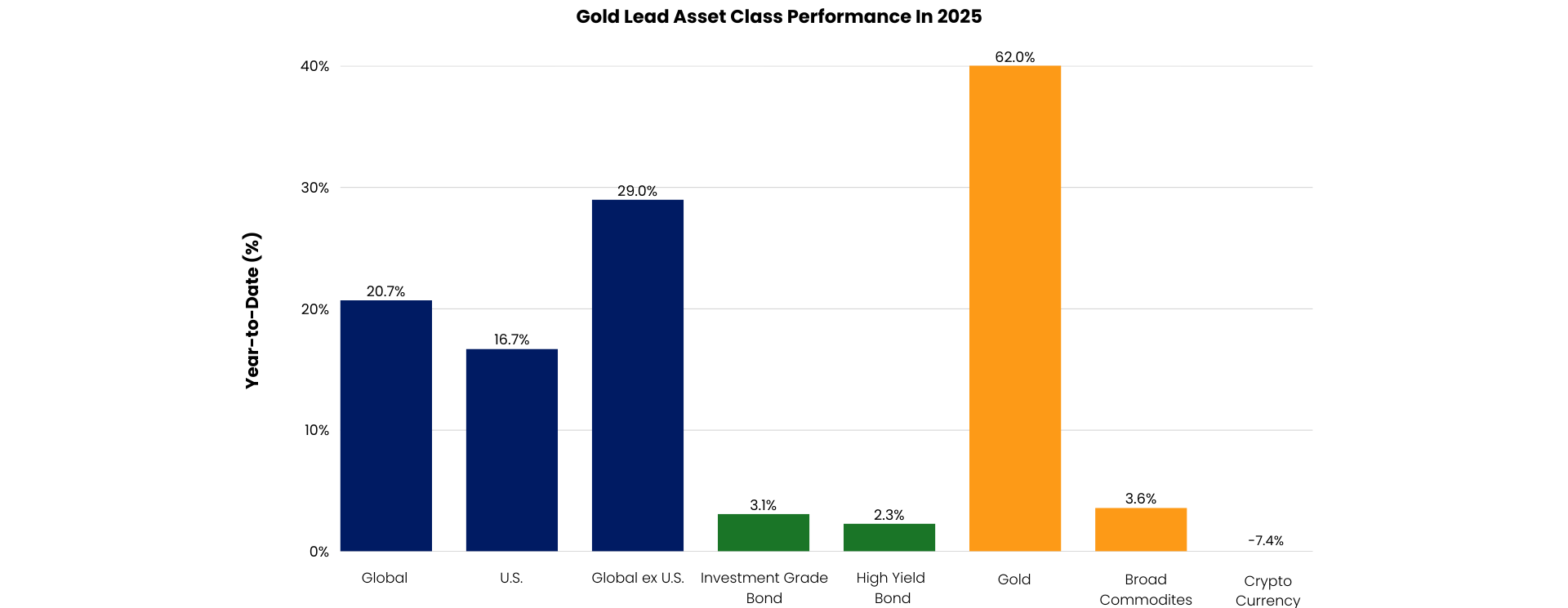
Sources: Investing.com, Metta Associates.
Data from Tickers: ACWI(Global), VOO(U.S.), ACWX(Global ex U.S.), LQD(Investment Grade), HYG(High Yield), GLDM(Gold), Bitcoin(Cryptocurrency).
Performance Period: 1 Jan 2025 - 31 Dec 2025.
This mix of chaos and innovation led to remarkable returns across the board. Gold surged to an all-time high, delivering returns roughly three times higher than equities.. While U.S. equities advanced on the back of strong earnings, AI-driven innovation, and fiscal stimulus, this growth was highly concentrated in a small group of large technology companies. In contrast, global ex-U.S. markets delivered stronger overall performance, supported by a broader-based expansion across multiple industries and additional tailwinds from favorable currency movements.Having navigated this intense landscape, we now turn our focus to the new opportunities and strategies awaiting us in the 2026 Outlook.
To navigate such volatility, we reviewed 2026 outlooks from global banks, asset managers, and independent research houses such as J.P. Morgan, BlackRock, and UBS. then merged their views with our own analysis. The result is a concise synthesis of how shifting macro forces, valuations, and policy paths may shape risks and opportunities in 2026.
Three Forces are Likely to Define the Investment Backdrop in 2026
Turning AI Potential into Proven Profit
The AI landscape has matured from a period of conceptual hype into a tangible business era focused on infrastructure and measurable returns. This transition is being spearheaded by hyperscalers aggressively scaling their capital expenditure to expand data centers and secure latest-generation GPUs,28 29 a shift that continues to empower chip makers and power utilities while pressuring legacy software providers to adapt or face obsolescence.30 31 As the market shifts from building AI technology to actually making money from it, the biggest winners are no longer just the tech providers.32 Instead, companies in sectors such as finance, healthcare, and manufacturing are emerging ahead by using AI to reduce labor costs and improve day-to-day efficiency.33 34
However, this momentum is not without risks. Beyond physical limits such as shortages of power and water,35 36 there are growing concerns about capital circulating within a small group of major players, where investment flows repeatedly between AI developers and their largest customers.37 This raises the risk that AI valuations may be overstated.38 If real profits fail to grow in line with the massive investment being made, the market could face the risk of an AI bubble forming.39
How National Security Shapes the Market
Governments are increasingly prioritizing national security as a primary driver of economic policy, directing substantial capital toward infrastructure and defense to ensure long-term resilience.40 41 42 A pivotal element of this strategy is the One Big Beautiful Bill Act (OBBBA), signed in 2025.43 44 It is projected to serve as the primary engine of the U.S. economy in 2026, contributing a direct GDP boost of 0.5% to 0.7% through significant fiscal stimulus and liquidity injections.45 46 While this spending creates clear tailwinds for the construction, materials, and defense industries, the resulting surge in debt issuance exerts downward pressure on government bond valuations.47 48 The prevailing macro risk remains that elevated debt levels could sustain higher interest rates, ultimately challenging equity valuations as the market balances immediate economic momentum against long-term fiscal stability.49 50
Prioritizing Security Over Cost
The world is shifting its focus from finding the cheapest costs to ensuring security and resilience in supply chains, driven by the U.S.-China competition and tightening trade policies.51 52 Notably, with the U.S. effective tariff rate expected to hit 15%-20% in 2026, there is a growing momentum toward onshoring and near-shoring to secure production lines despite the trade-off of higher costs.53 This shift favors North America and India as production moves closer to end markets, while China and Europe face much higher export costs.54 The resulting higher inflation floor stands as the primary risk, as domestic manufacturing remains costlier than traditional outsourcing.55
Macroeconomic

The U.S. remains the primary global growth engine, sustained by the fiscal tailwinds of the OBBBA stimulus.56 57 58 59 60 While this supports resilient GDP growth, the economy faces inflation that is over target, driven by trade tariffs and labor constraints, which is likely to keep the Federal Reserve's neutral rates elevated, with scope for rate cuts toward the end of the year.61 62 63 64 65 However, the long-term trajectory is clouded by mounting public debt, which remains a critical structural risk for investors.66 67 68 69
China is undergoing a high-stakes transition as it pivots from property-led growth toward new productive forces like AI, EVs, and green energy.70 71 While these sectors act as a buffer against deflationary pressures, the broader recovery is tempered by sluggish domestic demand and trade tensions. China's success in 2026 depends on balancing domestic regulation with the need to restore international investor confidence.72 73
In 2026, Thailand faces a structural reckoning as global protectionism and trade shifts intensify pressure on its traditional manufacturing core. Amidst this transition, a strategic FDI pivot is gaining momentum, marked by successful inroads into high-value sectors such as data centers and semiconductor supply chains. However, the sustainability of this technological leap depends on the upcoming general election, which stands as a critical inflection point. The outcome will be the ultimate arbiter of policy continuity, determining Thailand's ability to solidify these investment gains and navigate an increasingly volatile geopolitical landscape.74
Asset Class

The 2026 outlook is generally positive for equities, with many large investors expecting growth to extend beyond a small group of technology leaders and show up across more sectors. This view is supported by continued investment in AI infrastructure such as data centers, energy, and networks as well as ongoing government spending that helps support economic activity.75 76 77 78 79 80 Together, these forces are expected to drive healthier and more widespread earnings growth. At the same time, commodities are gaining importance: gold is seen as a safeguard against geopolitical uncertainty and policy surprises, while industrial metals matter because technological growth ultimately depends on real-world inputs like energy and raw materials.81 82 83 84 85
Fixed Income, however, are viewed more cautiously.86 While current yields are attractive and worth locking in,87 large government deficits could keep interest rates higher and lead to more price swings.88 89 As a result, many investors are becoming more selective with their fixed income holdings while limiting risk. A key change for 2026 is that equity and fixed income may move more closely together than in the past, reducing their ability to balance each other.90 91 92 93 94
Equity

Regional
As we venture into 2026, the U.S. equity market is transitioning into a high-conviction era of AI monetization, where financially strong balance sheets allow industry leaders to translate technological innovation into tangible bottom-line efficiency.95 96 97 98 This structural tailwind is further amplified by a massive liquidity injection from the OBBBA tax refunds, providing a robust fiscal cushion as the year begins.99 100 101 Parallel to this, emerging markets are redefining their role as the indispensable backbone of global trade.102 103
China+1 (diversifying production beyond China to mitigate supply chain and tariff risks) and near-shoring trends have matured into a powerful engine of growth, positioning India as a preeminent hub for service-led expansion.104 105 Simultaneously, strategic hubs like Mexico and Vietnam continue to reap the rewards of a fundamental global production reshuffle, fortifying their structural resilience and cementing a new era of regional prosperity.106 107
Sector
Heading into 2026, the equity narrative is defined by a powerful synergy between the technology and industrial sectors, which are acting as twin engines of long-term structural growth and shaping the next phase of market leadership.108 109 110 The technology sector is moving beyond speculative infrastructure investment into a high-confidence monetization phase, where the adoption of agentic AI is delivering measurable returns across software platforms and shifting the focus toward profitability and efficiency.111 112 113 114
At the same time, the industrial sector has evolved beyond its traditional cyclical role to become a core pillar of national security and economic independence.115 116 117 This shift is driven by accelerating global reshoring and sustained government spending, leading to a multi-year expansion in defense, infrastructure, and strategic security investment.118 119 120 Crucially, industrial capabilities, particularly in power management and advanced cooling systems, now provide the physical foundation required for AI-driven digital growth, creating an integrated ecosystem of infrastructure and intelligence that defines market leadership as we move into 2026.121 122 123 124
Conversely, Consumer Staples is now the least favored sector, burdened by eroding pricing power and an inability to pass through rising costs from tariffs and near-shoring.125 With capital rotating toward fiscal-driven infrastructure and AI growth, the sector faces a persistent margin squeeze and high opportunity cost, struggling to compete with the structural efficiency gains defining the new market leaders.126 127
Fixed Income
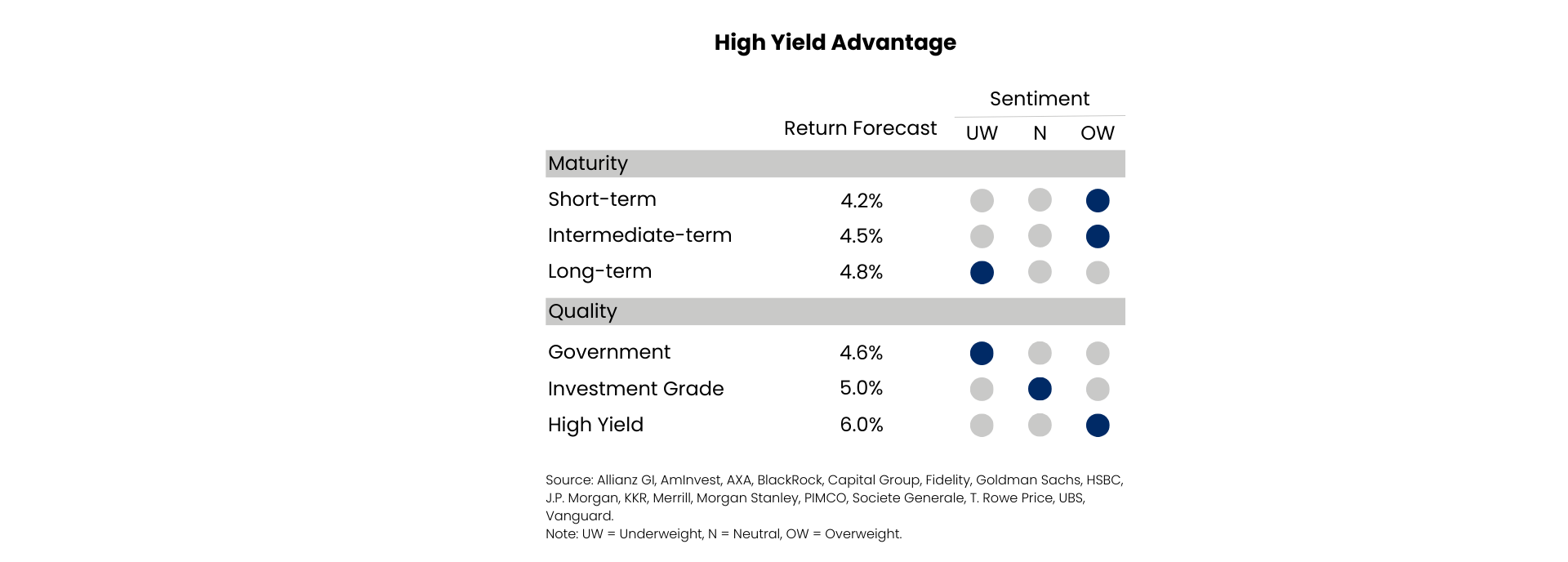
The 2026 global fixed income landscape has transitioned from interest rate volatility to a dedicated pursuit of sustainable cash flow.128 129 The first standout flagship is the intermediate-term segment, the strategic sweet spot130 as investors pivot away from long-term pressure by fiscal discipline concerns and an oversupply of government securities, choosing instead to lock in yields within a manageable risk framework.131 132
Concurrently, the second key flagship is the strategic embrace of high yield,133 134 underpinned by robust economic resilience and lower-than-expected default risks.135 136 137 This confidence allows investors to prioritize credit spreads as the primary engine for total return,138 moving beyond a passive reliance on capital gains from falling rates and toward a more proactive, yield-driven strategy that captures the strength of the real economy.139 140 141
Commodities

Precious Metals
In part of commodities, gold is largely shaped by concerns over governments' ability to sustain rising debt levels and maintain fiscal discipline.142 As a result, gold continues to play a key role as a hedge against expanding public debt and a global monetary policy environment that is settling into a new balance.143 144 145 In contrast, silver is increasingly viewed as a critical industrial metal supporting the expansion of AI technologies and the transition to clean energy.146 147 However, its performance is influenced by opposing forces, strong industrial demand on one side and a macroeconomic backdrop that remains only partially supportive on the other.148 This dynamic highlights a growing split within the metals space: gold remains centered on capital preservation, while silver's performance is more closely linked to the pace of technological and industrial growth.149
Oil
For crude oil, the market is confronting long-term fundamental changes in the market rather than a temporary price cycle. The main downward pressure comes not only from rising output by non-OPEC+ producers but also from a significant shift in demand behavior.150 151 Most notably in China, the rapid adoption of electric vehicles and alternative energy sources is beginning to have a lasting impact on crude oil consumption.152 As a result, the 2026 market has become a battleground between producers competing for market share and a global economy that is steadily reducing its reliance on fossil fuels, leaving oil in a challenging position amid multiple, persistent pressures.153 154
Agreement & Controversies
Agreement
- From AI Hype to Infrastructure & Monetization: The artificial intelligence narrative has matured into its second phase, transitioning from software-centric models toward physical AI and tangible infrastructure. Hyperscalers are accelerating capital expenditure with a renewed focus on realizing concrete monetization and driving measurable productivity gains across industrial and corporate sectors.155 156 157 158 159 160 161
- Global Monetary Normalization: A significant transition is underway as major central banks steer policy toward a neutral rate expected to stabilize around the 3.0-3.3% range. This pivot signifies the end of the cash-dominant era. As liquidity yields diminish, institutional capital is migrating toward risk assets and intermediate-duration fixed income to capture more sustainable returns.162 163 164 165 166
- The Security of Everything: The global economic paradigm has shifted from cost-efficiency to supply resilience. Strategic priorities now favor sectors poised to benefit from reshoring and friend-shoring initiatives.167 168 169 170 171
- Japan's Corporate Renaissance: Japan stands out as a primary strategic focus within developed markets. Driven by Sanaenomic, a combination of fiscal stimulus and rigorous corporate governance reform, the nation is successfully unlocking value through improved capital efficiency. The focus on increasing return on equity and redistributing excess balance sheet cash marks a secular turning point for the Japanese market.172 173 174 175 176
- Procyclical Fiscal Impulse: Global growth in 2026 is being anchored by a synchronized wave of fiscal expansion. From the tax-relief mechanisms of the OBBBA in the United States to Germany's commitment to large-scale infrastructure renewal, these fiscal engines are providing a crucial backstop, ensuring a recovery for the global economy.177 178 179 180 181
Controversies
- The Sustainability of AI Capital Expenditure: Debate persists over whether current spending represents an existential investment for long-term survival or a cycle where companies fund their own customers to buy their services, creating an illusion of growth alongside diminishing returns. The core uncertainty remains whether this capital intensity will drive a new era of productivity or culminate in a traditional market bubble.182 183 184 185 186 187
- Inflation Dynamics and the Neutral Rate: A tug-of-war exists between the inflation that remains persistent due to tariffs driven by tariffs and the disinflationary AI view, which anticipates that productivity breakthroughs will allow central banks to ease policy more aggressively than current market pricing suggests.188 189 190 191 192
- The Destiny of the US Dollar: The greenback's trajectory is contested by a bearish narrative of yield convergence and a multipolar world versus the U.S. exceptionalism perspective, which argues the dollar remains the indispensable operating system of the global economy with no viable alternative.193 194 195 196 197
- The Role of Fixed Income: Institutional sentiment is split between viewing fixed income as essential risk ballast and a reliable source of carry versus a more defensive stance triggered by mounting public debt levels and the potential erosion of the traditional fixed income-equity correlation.198 199 200 201 202
- Weighing China's Policy Potential Against Structural Risks: The outlook remains highly divided, balancing the short-term investment potential from policy adjustments and advances in high-technology sectors against ongoing structural challenges, including property-sector stress and continuous deflationary pressures.203 204 205 206 207 208
Key Takeaways:
Synergy of AI Monetization and Physical Infrastructure
The AI landscape has shifted from hype toward physical AI where technology and industrials act as interdependent growth engines. Capital is aggressively scaling toward data centers and power utilities, prioritizing measurable monetization and operational efficiency over speculative software build-outs.
Security and Resilience over Cost
Global policy has pivoted from a singular focus on cost-efficiency toward national security and economic resilience. Governments now view supply chains not just as a business decision but as a strategic asset. As a result, policies increasingly encourage onshoring and near-shoring, aiming to reduce dependence on geopolitically sensitive regions and minimize the risk of sudden disruptions.
This shift reflects lessons learned from recent shocks, trade conflicts, pandemics, and geopolitical tensions which exposed the vulnerability of overly concentrated global supply chains. While this approach may raise short-term costs, policymakers are prioritizing reliability, control, and continuity of production over marginal cost savings. Over the long run, this transition is reshaping global trade flows, investment patterns, and corporate strategy, with countries offering incentives to attract manufacturing capacity and critical industries back within trusted borders.
OBBBA as the Primary Engine of the U.S. Growth
The OBBBA serves as the central catalyst for the U.S. economy. While this fiscal stimulus anchors growth in construction and defense, the resulting debt surge exerts downward pressure on bond valuations and challenges long-term fiscal stability.
Metta Associates's Strategic Reflection
2025 Market Performance & Portfolio Resilience
In 2025, gold dominated headlines with a remarkable surge of over 60.0%. However, these gains were accompanied by extreme volatility and a high price for those unprepared. While global equities faced an -18.4% drawdown and commodities plunged by -37.4%, our simulated multi-asset portfolio (60% Equities, 35% Fixed Income, 5% Gold) demonstrated its true resilience.
By delivering a 20.0% return and limiting maximum losses to just -11.6%, the strategy proved its worth. At Metta Associates, we view this as a vital reminder: chasing performance without a balanced framework creates unsustainable risk-especially for wealth intended for your near-term milestones.
Lessons from the Tariff Shock: Discipline over Emotion
The necessity of discipline was vividly illustrated during the "Tariff Shock" in early April 2025. News of new tariffs triggered a wave of panic selling, erasing 9%-11% of market value in just two days. While many investors reacted emotionally, fearing a deeper crisis, the downturn proved short-lived. As anxiety subsided, the market staged a sharp single-day recovery, reclaiming much of what was lost.
This episode offers a crucial lesson for long-term investors: short-term market drops are often fueled by sentiment rather than shifts in fundamentals. Those who sold during the dip merely locked in their losses and missed the rebound. In contrast, those who remained disciplined were positioned to benefit fully when prices bounced back.
The Metta Approach: Stability Through Personalization
Ultimately, we believe true stability is rooted in personalization, not in speculating on a single market outcome. By tailoring strategies to your unique time horizon and risk tolerance, we ensure your portfolio is engineered to thrive in any scenario.
This bespoke approach allows Metta Associates to transform market uncertainty into long-term security, keeping your financial journey in harmony with your goal—always with you.
Appendix A: List of Referenced Financial Institutions
| Financial Institution | Type | Link |
|---|---|---|
| AmInvest | Asset Manager | View |
| Amundi | Asset Manager | View |
| Apollo | Asset Manager | View |
| AXA | Asset Manager | View |
| Bank Of America | Investment Bank | View |
| Barclays | Investment Bank | View |
| Blackrock | Asset Manager | View |
| BNY Mellon | Asset Manager / Custodian | View |
| BOT | Central Bank | View |
| Capital Group | Asset Manager | View |
| Carlyle Group | Asset Manager | View |
| Charles Schwab | Asset Manager / Brokerage | View |
| Citadel | Asset Manager | View |
| Deloitte | Professional Services | View |
| EY | Professional Services | View |
| Fidelity | Asset Manager | View |
| Franklin Templeton | Asset Manager | View |
| Goldman Sachs | Investment Bank | View |
| HSBC | InvestmentBank / Commercial Bank | View |
| IMF | International Institution | View |
| JPMorgan Asset Management | Asset Manager | View |
| JPMorgan Wealth Management | Wealth Management | View |
| KKR | Asset Manager | View |
| KPMG | Professional Services | View |
| Man Group | Asset Manager | View |
| Morgan Stanley | Investment Bank | View |
| MUFG | Commercial Bank | View |
| Oaktree | Asset Manager | View |
| PIMCO | Asset Manager | View |
| Societe Generale | Investment Bank | View |
| T. Rowe Price | Asset Manager | View |
| UBS | Wealth Manager / Investment Bank | View |
| Vanguard | Asset Manager | View |
| World Gold Council | Industry Association | View |
Appendix B: Global Macroeconomic Overview
| Region | Growth | Inflation | Central Bank Policy Rate |
Analysis Summary |
|---|---|---|---|---|
| World | 2.87% | 3.10% | N/A | The global economy is undergoing a significant structural transformation, as productivity gains from AI serve as a supply-side counterweight to the headwinds of trade wars and supply chain fragmentation. |
| U.S. | 2.03% | 2.71% | 3.13% | The U.S. economy stands to benefit from the OBBBA policy and the maturing of AI capital expenditures moving from infrastructure setup to yield generation. Despite this, tariff barriers continue to exert upward pressure, resulting in sticky inflation that complicates the macro outlook. |
| Europe | 1.18% | 1.86% | 2.00% | Europe is transitioning from an export-dependent growth model toward strategic autonomy. This shift is being spearheaded by a massive fiscal expansion in Germany, aimed at revitalizing national infrastructure and strengthening defense capabilities. |
| Japan | 0.67% | 1.97% | 1.00% | Japan is increasingly successfully exiting the deflationary era, transitioning into a virtuous cycle where positive real wage growth acts as a primary catalyst for domestic consumption. This structural shift is being reinforced by the Takaichi administration’s strategic emphasis on high-tech investment and the ongoing maturation of corporate governance reforms. |
| China | 4.55% | 0.43% | N/A | China is actively addressing industrial overcapacity while leveraging the success of innovative enterprises, such as DeepSeek, to underpin the economy as the real estate sector continues its structural adjustment. |
| Thailand | 1.50% | 0.43% | 1.25% | Thailand faces a structural reckoning as global protectionism pressures its traditional manufacturing core, prompting a strategic FDI pivot toward Data Centers and Semiconductors. However the upcoming election serves as a critical inflection point. This political outcome will ultimately determine policy continuity and Thailand’s resilience amidst an increasingly volatile geopolitical landscape. |
| Emerging Market | 4.05% | 4.70% | N/A | Emerging markets has high-conviction growth centered on India’s consumption boom and North Asia’s AI hardware dominance. While shifting US trade regimes and sovereign debt present potential headwinds, accelerating corporate reforms in China and South Korea are creating significant upside. |
Sources: AmInvest, Bank of Thailand, Capital Group, Deloitte, EY, IMF, KKR, KPMG, Societe Generale, T. Rowe Price, UBS, Vanguard.
Appendix C: Asset Class Perspectives
| Sub-Category | Category | Return Forecast | Sentiment Count | OW | N | UW | Analysis Summary | |
|---|---|---|---|---|---|---|---|---|
Equity | Regional | China | 13.00% | 7 | 43% | 57% | 0% | Tech and EV leadership vs. real estate crisis and trade wars. Low valuations attract some, but high unemployment and U.S. tariffs remain major obstacles to growth. |
| Regional | Eurozone | 11.40% | 8 | 50% | 50% | 0% | Support from German fiscal policy and defense spending. Risks involve trade tariffs on autos, energy costs, and political instability. Low valuations and wage growth offer long-term recovery potential. | |
| Regional | Japan | 10.90% | 6 | 83% | 17% | 0% | Benefit from corporate reforms and wage growth. Risks include BoJ rate hikes and weak local consumption. High cash reserves for buybacks support share prices despite global trade friction. | |
| Regional | Emerging Markets | 10.20% | 8 | 75% | 25% | 0% | Strong India consumption and supply chain shifts (Mexico/Vietnam) drive growth. Risks include USD volatility and high external debt. Early rate cuts in some EM nations provide a growth cushion. | |
| Regional | U.S. | 9.20% | 11 | 73% | 18% | 9% | Growth driven by AI infrastructure and fiscal support. Risks include an AI bubble, high valuations, and inflation from trade tariffs. Rate cuts support earnings, but high public debt is a concern. | |
| Cyclical Sector | Basic Materials | 18.0%* | 7 | 57% | 29% | 14% | Driven by resource security and AI-related metal demand. Risks include global oversupply from OPEC+ and China’s construction slowdown. High interest rates may pressure heavy industry costs. | |
| Cyclical Sector | Consumer Cyclical | 13.0%* | 5 | 80% | 20% | 0% | High-income spending and tourism recovery are key drivers. Risks include cost-of-living pressure for mid-low earners and potential price hikes due to import tariffs. | |
| Cyclical Sector | Financial Services | 9.6%* | 10 | 80% | 20% | 0% | US deregulation and steeper yield curves boost bank margins. Risks include rising default rates in private credit and competition from digital payments and FinTech. | |
| Cyclical Sector | Real Estate | 9.2%* | 7 | 43% | 29% | 28% | Low housing supply and AI data center demand support prices. Risks involve a major office debt crisis and high refinancing costs for loans maturing in 2026. | |
| Sensitive Sector | Industrials | 20.9%* | 7 | 86% | 14% | 0% | Growth in defense and automation spending. Risks include high labor costs and supply chain shifts due to trade wars. U.S. and German fiscal spending support local manufacturing. | |
| Sensitive Sector | Technology | 18.0%* | 9 | 78% | 22% | 0% | High demand for AI chips and software monetization. Risks include antitrust scrutiny and "bubble" valuations. However, Backlogs for GPUs suggest strong revenue through 2026. | |
| Sensitive Sector | Energy | 11.1%* | 6 | 67% | 33% | 0% | Data center power needs boost gas and nuclear demand. Risks include volatile oil prices, OPEC+ production increases, and long-term pressure from the green energy transition. | |
| Sensitive Sector | Communication Services | 3.9%* | 3 | 67% | 33% | 0% | AI-driven ad revenue and strong cash flows support buybacks. Risks include antitrust laws and market saturation in developed regions. | |
| Defensive Sector | Utilities | 9.9%* | 4 | 50% | 25% | 25% | AI-driven electricity demand is positive. Risks include high debt sensitivity to interest rates and government caps on electricity prices. | |
| Defensive Sector | Healthcare | 9.7%* | 6 | 83% | 17% | 0% | Driven by weight-loss drug demand and gene-editing breakthroughs. Risks include US government drug price controls and high failure rates in clinical trials. | |
| Defensive Sector | Consumer Defensive | 7.2%* | 4 | 0% | 50% | 50% | A safe haven during volatility with steady dividends. Risks include competition from generic brands and rising raw material/transportation costs. | |
Fixed Income | Maturity | Short-term | 4.20% | 8 | 63% | 38% | 0% | Benefits from rate cuts and low duration risk. Risks include sticky inflation at 3% and new tariffs preventing further rate decreases by the Fed. |
| Maturity | Intermediate | 4.50% | 9 | 78% | 22% | 0% | Balanced risk/reward as yield curves normalize. Risks include a massive US bond supply to fund deficits and high real yields driven by AI investment needs. | |
| Maturity | Long-term | 4.80% | 11 | 18% | 36% | 45% | Acts as a hedge against recession. Risks include high "Term Premium" due to rising US debt levels and a positive correlation with stocks during inflation. | |
| Quality | Government Bonds | 4.60% | 9 | 22% | 33% | 44% | Safe-haven appeal as rates settle. Risks include high fiscal deficits and "Fiscal Dominance," where politics may keep inflation higher than targets to reduce debt. | |
| Quality | Investment Grade | 5.00% | 8 | 38% | 25% | 38% | Strong corporate cash flows and high interest coverage. Risks include very tight credit spreads and potential downgrades if the economy slows significantly. | |
| Quality | High Yield | 6.00% | 8 | 63% | 38% | 0% | Higher average quality (BB) and strong M&A activity. Risks involve a "refinancing wall" in 2026-2027 and hidden liquidity issues in private lending. | |
Commodities | Precious Metals | Gold | 5.00% | 8 | 75% | 25% | 0% | Supported by central bank buying and geopolitics. Risks include a strong USD, profit-taking after record highs, and reduced risk premiums if conflicts ease. |
| Precious Metals | Silver | N/A | 3 | 33% | 67% | 0% | High industrial demand from the solar and AI sectors. Risks include high price volatility and sensitivity to global manufacturing slowdowns. | |
| Energy | Crude Oil | N/A | 5 | 0% | 60% | 40% | OPEC+ price support vs. China’s slowdown and EV transition. High shale production in the US and potential peace in Ukraine could lead to oversupply and lower prices. |
Sources: AmInvest, AXA, Bank of America, Bank of Thailand, BlackRock, BNP, Oaktree, Capital Group, Carlyle, Charles Schwab, Citadel, Deloitte, EY, Fidelity Investments, Franklin Templeton, Goldman Sachs, HSBC, IMF, J.P. Morgan Asset Management, J.P. Morgan Wealth Management, KKR, KPMG, Morgan Stanley, PIMCO, Societe Generale, T. Rowe Price, UBS, Vanguard, World Gold Council.
Note: All sector's forecast returns are U.S. only. UW = Underweight, N = Neutral, OW = Overweight.
1 Goldman Sachs Investment Outlook 2026, 18 November 2025
2 J.P. Morgan Wealth Management Outlook 2026, 27 October 2025
3 KKR Outlook 2026, December 2025
4 Axa The Investment Outlook For 2026, 11 November 2025
5 Capital Group 2026 Investment Outlook, 18 December 2025
6 T.Row Price 2026 Global Market Outlook, November 2025
7 IMF World Economic Outlook, October 2025
8 J.P. Morgan Wealth Management Outlook 2026, 27 October 2025
9 Goldman Sachs Investment Outlook 2026, 18 November 2025
10 Blackrock 2026 Global Outlook, 2 December 2025
11 Goldman Sachs Investment Outlook 2026, 18 November 2025
12 J.P. Morgan Wealth Management Outlook 2026, 27 October 2025
13 T.Row Price 2026 Global Market Outlook, November 2025
14 Capital Group Outlook 2026, 18 December 2025
15 Charles Schwab2026 Outlook: U.S. Stocks and Economy, 9 December 2025
16 Goldman Sachs Investment Outlook 2026, 18 November 2025
17 J.P. Morgan Wealth Management Outlook 2026, 27 October 2025
18 Goldman Sachs Investment Outlook 2026, 18 November 2025
19 Capital Group Outlook 2026, 18 December 2025
20 Goldman Sachs Investment Outlook 2026, 18 November 2025
21 T.Row Price 2026 Global Market Outlook, November 2025
22 Blackrock 2026 Global Outlook, 2 December 2025
23 J.P. Morgan Wealth Management Outlook 2026, 27 October 2025
24 Bank of America Outlook 2026, 17 November 2025
25 Goldman Sachs Investment Outlook 2026, 18 November 2025
26 Bank of America Outlook 2026, 17 November 2025
27 UBS Year Ahead 2026, 20 November 2025
28 T.Row Price 2026 Global Market Outlook, November 2025
29 Goldman Sachs Investment Outlook 2026, 18 November 2025
30 Capital Group Outlook 2026, 18 December 2025
31 J.P. Morgan Wealth Management Outlook 2026, 27 October 2025
32 Charles Schwab2026 Outlook: U.S. Stocks and Economy, 9 December 2025
33 Capital Group Outlook 2026, 18 December 2025
34 Charles Schwab2026 Outlook: U.S. Stocks and Economy, 9 December 2025
35 Goldman Sachs Investment Outlook 2026, 18 November 2025
36 J.P. Morgan Wealth Management Outlook 2026, 27 October 2025
37 Charles Schwab2026 Outlook: U.S. Stocks and Economy, 9 December 2025
38 Fidelity Economic Outlook 2026, 9 December 2025
39 Blackrock 2026 Global Outlook, 2 December 2025
40 Societe Generale Asia's 2026 Market Outlook, 12 November 2025
41 Goldman Sachs Investment Outlook 2026, 18 November 2025
42 J.P. Morgan Wealth Management Outlook 2026, 27 October 2025
43 Citadel Securities 2026 - Q1 Outlook, 18 December 2025
44 Morgan Stanley 2026 Outlook, 3 December 2025
45 Citadel Securities 2026 - Q1 Outlook, 18 December 2025
46 MUFG Macro2Markets: 2026 Outlook, 19 December 2025
47 Goldman Sachs Investment Outlook 2026, 18 November 2025
48 T.Row Price 2026 Global Market Outlook, November 2025
49 T.Row Price 2026 Global Market Outlook, November 2025
50 Fidelity Economic Outlook 2026, 9 December 2025
51 Axa The Investment Outlook For 2026, 11 November 2025
52 IMF World Economic Outlook, October 2025
53 EY 2026 Global Economic Outlook, 15 December 2025
54 Deloitte Global economic outlook 2026, 19 December 2025
55 Charles Schwab2026 Outlook: U.S. Stocks and Economy, 9 December 2025
56 Charles Schwab2026 Outlook: U.S. Stocks and Economy, 9 December 2025
57 Fidelity Economic Outlook 2026, 9 December 2025
58 Citadel Securities 2026 - Q1 Outlook, 18 December 2025
59 EY 2026 Global Economic Outlook, 15 December 2025
60 T.Row Price 2026 Global Market Outlook, November 2025
61 EY 2026 Global Economic Outlook, 15 December 2025
62 Charles Schwab 2026 Outlook: U.S. Stocks and Economy, 9 December 2025
63 Axa The Investment Outlook For 2026, 11 November 2025
64 T.Row Price 2026 Global Market Outlook, November 2025
65 Vanguard 2026 Economic and Market Outlook, 10 December 2025
66 Blackrock 2026 Global Outlook, 2 December 2025
67 Fidelity Economic Outlook 2026, 9 December 2025
68 T.Row Price 2026 Global Market Outlook, November 2025
69 Axa The Investment Outlook For 2026, 11 November 2025
70 Blackrock 2026 Global Outlook, 2 December 2025
71 KPMG China Economic Monitor, November 2025
72 Societe Generale Asia's 2026 Market Outlook, 12 November 2025
73 J.P. Morgan Wealth Management Outlook 2026, 27 October 2025
74 Bank Of Thailand Press Conference Monetary Policy Committee Decision 6/2568, 17 December 2025
75 Blackrock 2026 Global Outlook, 2 December 2025
76 Charles Schwab2026 Outlook: U.S. Stocks and Economy, 9 December 2025
77 Citadel Securities 2026 - Q1 Outlook, 18 December 2025
78 Goldman Sachs Investment Outlook 2026, 18 November 2025
79 HSBC 2026 Investment Outlook, November 2025
80 T.Row Price 2026 Global Market Outlook, November 2025
81 Blackrock 2026 Global Outlook, 2 December 2025
82 HSBC 2026 Investment Outlook, November 2025
83 J.P. Morgan Wealth Management Outlook 2026, 27 October 2025
84 Pimco Investment Ideas for 2026, 3 December 2025
85 Morgan Stanley 2026 Outlook, 3 December 2025
86 Blackrock 2026 Global Outlook, 2 December 2025
87 J.P. Morgan Wealth Management Outlook 2026, 27 October 2025
88 Blackrock 2026 Global Outlook, 2 December 2025
89 Charles Schwab2026 Outlook: U.S. Stocks and Economy, 9 December 2025
90 Blackrock 2026 Global Outlook, 2 December 2025
91 Charles Schwab2026 Outlook: U.S. Stocks and Economy, 9 December 2025
92 KKR Outlook 2026, December 2025
93 Goldman Sachs Investment Outlook 2026, 18 November 2025
93 J.P. Morgan Wealth Management Outlook 2026, 27 October 2025
94 KKR Outlook 2026, December 2025
95 Blackrock 2026 Global Outlook, 2 December 2025
96 Fidelity Economic Outlook 2026, 9 December 2025
97 UBS Year Ahead 2026, 20 November 2025
98 J.P. Morgan Wealth Management Outlook 2026, 27 October 2025
99 Citadel Securities 2026 - Q1 Outlook, 18 December 2025
100 Bank of America Outlook 2026, 17 November 2025
101 T.Row Price 2026 Global Market Outlook, November 2025
102 Blackrock 2026 Global Outlook, 2 December 2025
103 J.P. Morgan Wealth Management Outlook 2026, 27 October 2025
104 Societe Generale Asia's 2026 Market Outlook, 12 November 2025
105 KKR Outlook 2026, December 2025
106 Blackrock 2026 Global Outlook, 2 December 2025
107 Societe Generale Asia's 2026 Market Outlook, 12 November 2025
108 Brookfield 2026 Outlook, 20 November 2025
109 J.P. Morgan Wealth Management Outlook 2026, 27 October 2025
110 T.Row Price 2026 Global Market Outlook, November 2025
111 Blackrock 2026 Global Outlook, 2 December 2025
112 Axa The Investment Outlook For 2026, 11 November 2025
113 J.P. Morgan Wealth Management Outlook 2026, 27 October 2025
114 T.Row Price 2026 Global Market Outlook, November 2025
115 Blackrock 2026 Global Outlook, 2 December 2025
116 Axa The Investment Outlook For 2026, 11 November 2025
117 T.Row Price 2026 Global Market Outlook, November 2025
118 UBS Year Ahead 2026, 20 November 2025
119 Brookfield 2026 Outlook, 20 November 2025
120 T.Row Price 2026 Global Market Outlook, November 2025
121 T.Row Price 2026 Global Market Outlook, November 2025
122 Brookfield 2026 Outlook, twenty November 2025
123 KKR Outlook 2026, December 2025
124 Goldman Sachs Investment Outlook 2026, 18 November 2025
125 KKR Outlook 2026, December 2025
126 KKR Outlook 2026, December 2025
127 Citadel Securities 2026 - Q1 Outlook, 18 December 2025
128 Blackrock 2026 Global Outlook, 2 December 2025
129 Pimco Investment Ideas for 2026, 3 December 2025
130 Blackrock 2026 Global Outlook, 2 December 2025
131 Pimco Investment Ideas for 2026, 3 December 2025
132 Axa The Investment Outlook For 2026, 11 November 2025
135 Axa The Investment Outlook For 2026, 11 November 2025
136 Carlyle 2026 Credit Outlook, 16 December 2025
137 T.Row Price 2026 Global Market Outlook, November 2025
138 Axa The Investment Outlook For 2026, 11 November 2025
139 Carlyle 2026 Credit Outlook, 16 December 2025
140 Pimco Investment Ideas for 2026, 3 December 2025
141 AmInvest Market Review & Outlook January 2026, December 2025
142 J.P. Morgan Asset Management Investment Outlook 2026, November 2025
143 J.P. Morgan Asset Management Investment Outlook 2026, November 2025
144 Pimco Investment Ideas for 2026, 3 December 2025
145 Blackrock 2026 Global Outlook, 2 December 2025
146 Citadel Securities 2026 - Q1 Outlook, 18 December 2025
147 J.P. Morgan Wealth Management Outlook 2026, 27 October 2025
148 Citadel Securities 2026 - Q1 Outlook, 18 December 2025
149 J.P. Morgan Wealth Management Outlook 2026, 27 October 2025
150 KKR Outlook 2026, December 2025
151 IMF World Economic Outlook, October 2025
152 KKR Outlook 2026, December 2025
153 KKR Outlook 2026, December 2025
154 IMF World Economic Outlook, October 2025
155 Blackrock 2026 Global Outlook, 2 December 2025
156 J.P. Morgan Asset Management Investment Outlook 2026, November 2025
157 Goldman Sachs Investment Outlook 2026, 18 November 2025
158 Fidelity Economic Outlook 2026, 9 December 2025
159 T.Row Price 2026 Global Market Outlook, November 2025
160 UBS Year Ahead 2026, 20 November 2025
161 Morgan Stanley 2026 Outlook, 3 December 2025
162 J.P. Morgan Asset Management Investment Outlook 2026, November 2025
163 Pimco Investment Ideas for 2026, 3 December 2025
164 Vanguard 2026 Economic and Market Outlook, 10 December 2025
165 Franklin Templeton Global Investment Outlook 2026, November 2025
166 Blackrock 2026 Global Outlook, 2 December 2025
167 KKR Outlook 2026, December 2025
168 Goldman Sachs Investment Outlook 2026, 18 November 2025
169 J.P. Morgan Wealth Management Outlook 2026, 27 October 2025
170 Axa The Investment Outlook For 2026, 11 November 2025
171 UBS Year Ahead 2026, 20 November 2025
172 Societe Generale Asia's 2026 Market Outlook, 12 November 2025
173 Deloitte Global economic outlook 2026, 19 December 2025
174 KKR Outlook 2026, December 2025
175 Goldman Sachs Investment Outlook 2026, 18 November 2025
176 Blackrock 2026 Global Outlook, 2 December 2025
177 J.P. Morgan Asset Management Investment Outlook 2026, November 2025
178 Citadel Securities 2026 - Q1 Outlook, 18 December 2025
179 T.Row Price 2026 Global Market Outlook, November 2025
180 Axa The Investment Outlook For 2026, 11 November 2025
181 UBS Year Ahead 2026, 20 November 2025
182 Charles Schwab2026 Outlook: U.S. Stocks and Economy, 9 December 2025
183 J.P. Morgan Wealth Management Outlook 2026, 27 October 2025
184 Blackrock 2026 Global Outlook, 2 December 2025
185 Citadel Securities 2026 - Q1 Outlook, 18 December 2025
186 T.Row Price 2026 Global Market Outlook, November 2025
187 Axa The Investment Outlook For 2026, 11 November 2025
188 Vanguard 2026 Economic and Market Outlook, 10 December 2025
189 Blackrock 2026 Global Outlook, 2 December 2025
190 Pimco Investment Ideas for 2026, 3 December 2025
191 Societe Generale Asia's 2026 Market Outlook, 12 November 2025
192 Franklin Templeton Global Investment Outlook 2026, November 2025
193 Franklin Templeton Global Investment Outlook 2026, November 2025
194 Pimco Investment Ideas for 2026, 3 December 2025
195 UBS Year Ahead 2026, 20 November 2025
196 J.P. Morgan Wealth Management Outlook 2026, 27 October 2025
197 Goldman Sachs Investment Outlook 2026, 18 November 2025
198 Blackrock 2026 Global Outlook, 2 December 2025
199 KKR Outlook 2026, December 2025
200 Morgan Stanley 2026 Outlook, 3 December 2025
201 Vanguard 2026 Economic and Market Outlook, 10 December 2025
202 Pimco Investment Ideas for 2026, 3 December 2025
203 Franklin Templeton Global Investment Outlook 2026, November 2025
204 UBS Year Ahead 2026, 20 November 2025
205 Societe Generale Asia's 2026 Market Outlook, 12 November 2025
206 Blackrock 2026 Global Outlook, 2 December 2025
207 Morgan Stanley 2026 Outlook, 3 December 2025
208 J.P. Morgan Asset Management Investment Outlook 2026, November 2025
Disclaimer
The information presented is based on sources believed to be reliable; however, its accuracy or completeness cannot be guaranteed. This material does not represent a forecast and should not be interpreted as a guarantee of future outcomes. It has been prepared with care and objectivity to support long-term, planning-focused financial decisions.