
The Financial Reality of ESG

The Financial Reality of ESG
ESG investing has firmly entered the mainstream. Many people view it simply as a way to do good—directing capital toward environmental protection and social causes while still earning financial returns.
In professional investment management, however, ESG is much more complex than just saving the planet. At its core, it is a systematic way to analyze risks and their direct impact on a company’s cash flow. Investors who fail to understand this bigger picture risk hurting their portfolio performance. Here, we examine the deeper mechanisms of ESG to show why it is a critical financial tool, rather than just an environmental label.
Understanding ESG in Finance: Beyond Charity and the Reality of Returns
In institutional investing, the financial core of ESG is not about sacrificing profits for the environment. Rather, it is a systematic process of pricing in external factors that significantly impact a company's cash flows and risk profile. To understand this clearly, we must separate two distinct frameworks:
- ESG Integration: This involves incorporating financially material environmental, social, and governance factors into traditional fundamental analysis. The primary goal is to maximize risk-adjusted returns within the fund's specific mandate.
- Impact Investing: This operates on a dual-objective model. Investors seek both financial returns and clear, measurable positive outcomes for society or the environment.
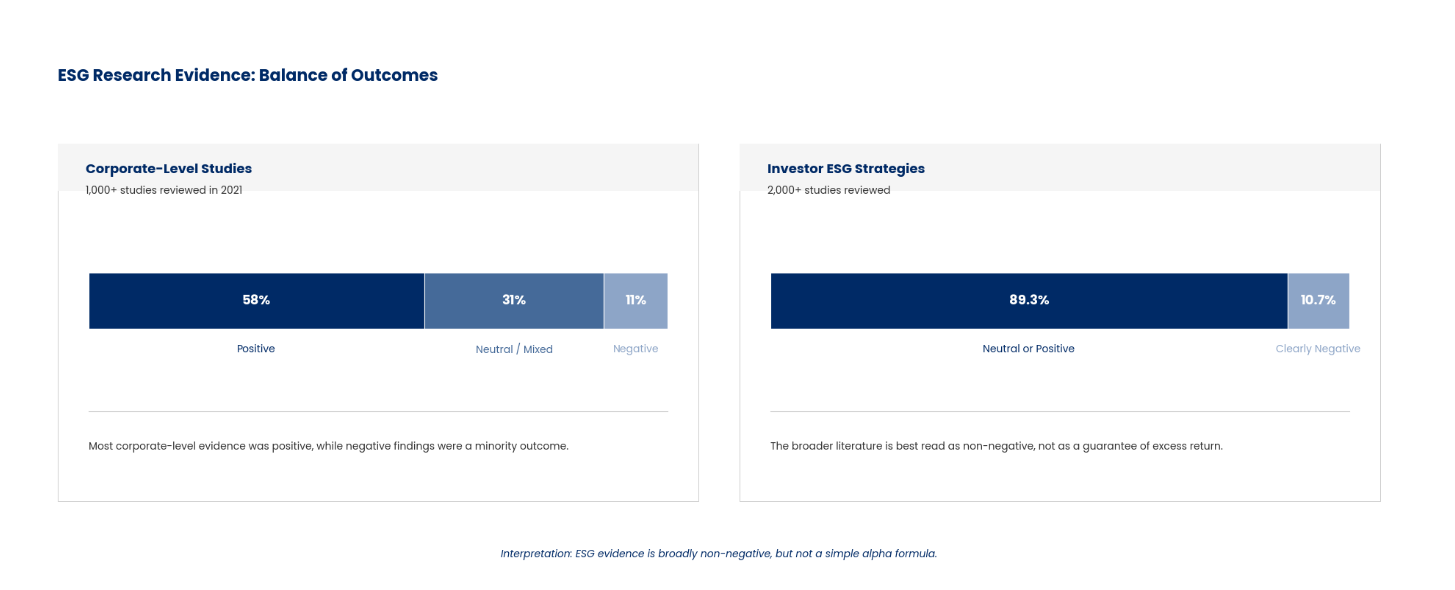
Source: Friede, Busch & Bassen (2015); Whelan, Atz & Van Holt (2021) – synthesized from cited meta-analyses. For illustrative purposes only. Based on cited academic literature. This chart is not a forecast, guarantee, or personalized investment recommendation.
This approach to risk assessment naturally leads to a key question: Does ESG actually generate higher profits? Real-world evidence from large-scale research (meta-analyses) suggests that ESG factors generally have a "non-negative" impact on returns. However, they are not a guaranteed formula for generating alpha (excess returns). The data shows:
- A 2021 Meta-analysis (1,000+ studies): Found that 58% of corporate-level studies indicated a positive relationship between ESG and financial performance. From an investor's perspective, 59% of studies showed that ESG strategies performed similarly to, or better than, traditional approaches.
- A Review of over 2,000 studies: Revealed that only 10.7% reported clearly negative outcomes. The vast majority demonstrated either neutral or statistically significant positive relationships.
The Core of "Materiality" and the Mechanics of Value Creation: How ESG Translates into Financial Numbers
ESG initiatives only impact a company's valuation when they are economically relevant to its specific business—a concept known in finance as "Materiality". These factors can be divided into two distinct categories:
- Material Issues: These are factors that directly affect a company's revenue and cost structure. For example, water management is critical for a semiconductor manufacturer, just as data security is vital for a fintech firm. When a company excels in these highly relevant areas, its financial performance tends to stand out.
- Immaterial Issues: These are sustainability efforts that are entirely unrelated to the core business model. They are often purely cosmetic investments aimed at improving public relations, and they do not reliably predict better financial outcomes.
The strategic takeaway for businesses is not to pursue ESG in every possible dimension, but rather to focus strictly on the "valuation levers" that matter most to their specific industry.
When a company invests in the right material ESG factors, these actions translate into hard financial numbers through two primary mechanisms:
1. Cash Flow Effects (Generating Cash and Cutting Costs): Proper ESG integration enhances revenue durability and reduces operating costs through better resource efficiency. Crucially, it also drives human capital retention—helping companies attract and keep top talent, which significantly cuts down the massive expenses associated with recruiting and training new employees.
2. Cost of Capital and Risk Mitigation (Discount Rate Effects): When a company effectively implements ESG, the market perceives it as fundamentally less risky. This strengthens the company's financials in two specific ways:
- Reducing the risk of severe crises: Good ESG practices help shield the company from sudden business disruptions, such as environmental lawsuits, labor disputes, or governance scandals (effectively lowering idiosyncratic and tail risks).
- Lower borrowing costs and the "Greenium": Because the company's risk profile is lower, investors feel safer and are willing to provide funding at a cheaper interest rate, lowering the company's cost of capital.
The Investor's Trade-off: The Reality of the "Greenium" However, from an investor's perspective, this creates a clear trade-off. When investors willingly pay a premium price to buy green stocks or environmentally friendly assets—a phenomenon known as the "Greenium"—it mathematically means their expected future returns will be lower, driven by basic pricing mechanics. It is not a source of "free alpha" or effortless excess returns, as the general public commonly misunderstands.
Measurement Divergence: Why ESG Scores Vary Across Providers
A core limitation of simply "investing by ESG score" is that ESG ratings are not standardized in the same way as traditional credit ratings. Investors cannot safely rely on a single provider's score because different rating agencies often disagree significantly on how a company actually performs.
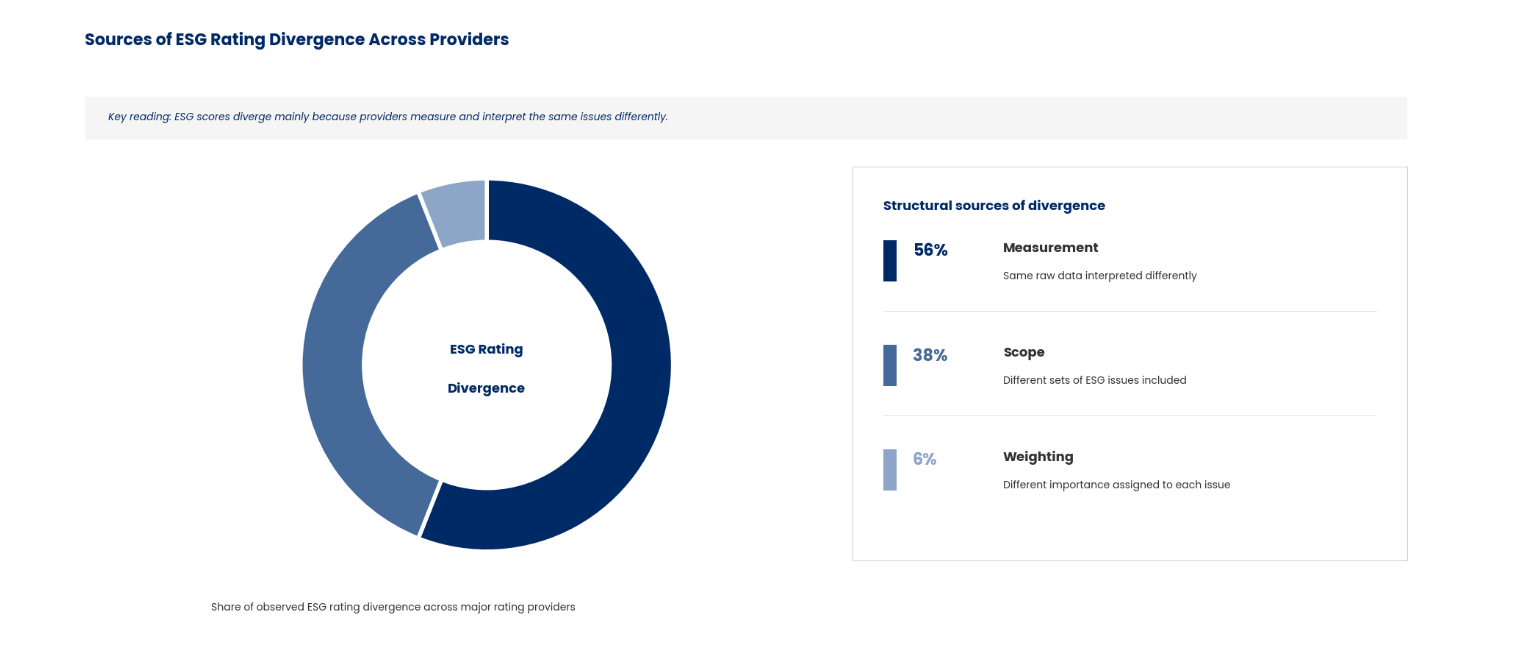
Source: Berg, Koelbel & Rigobon (2022), “Aggregate Confusion: The Divergence of ESG Ratings,” MIT Sloan Management Review. Data represents structural sources of divergence across major ESG rating providers. For illustrative summary purposes only.
Research shows that this "Rating Divergence" is driven by three main structural differences in how agencies evaluate businesses:
- Measurement (56%): Agencies often interpret the exact same raw data in completely different ways.
- Scope (38%): Agencies do not evaluate the same set of underlying factors; one might look at 50 variables while another looks at 100.
- Weighting (6%): Agencies assign different levels of importance to specific issues, meaning one might heavily penalize a company for carbon emissions while another cares more about labor practices.
A clear example of this is the case of Barrick Gold Corporation in 2014, where ratings from two major data providers (Refinitiv and KLD) showed a massive discrepancy. This wide gap was primarily driven by conflicting views on specific topics such as taxes, indigenous rights, business ethics, and executive remuneration.
This divergence serves as a critical warning for market participants. Investors must dig deeper into the raw data and understand the underlying methodology rather than taking a top-line ESG score at face value. Blindly following a single provider's score weakens investment incentives and increases the risk of misallocating capital—or, simply put, "hitting the target but missing the point".
Why "G" is the Most Critical Letter: Governance and the True Cost of Agency
In the ESG acronym, "G" (Governance) is undoubtedly the most important letter. It is the foundational engine that dictates whether a company's environmental (E) and social (S) initiatives will actually function effectively and create real value. Simply put, without strong governance, the rest of ESG falls apart.
This critical role of governance is driven by three core business realities:
- The Need for a Single Focus (Avoiding Strategic Confusion): Financial economist Michael C. Jensen argued that an organization cannot successfully maximize multiple goals at the same time. A business needs one primary objective—typically, maximizing long-term enterprise value. Strong governance ensures that ESG factors are managed strategically to support this main goal, rather than acting as competing distractions that confuse the company's direction.
- Controlling "Principal-Agent Risk": Without strict governance, companies face a major issue known as "agency costs". In simple terms, weak oversight allows management (the agents) to use ESG as a convenient excuse to avoid accountability to the shareholders (the principals). Executives might funnel company money into high-profile sustainability projects that boost their personal public image, but ultimately destroy shareholder wealth.
- Transparency and the Cost of Conscience: Valuation expert Aswath Damodaran points out a hard truth: sticking to corporate values is commendable, but it usually costs money. A solid governance structure forces management to be entirely transparent about these financial trade-offs. If a company chooses to pursue an expensive sustainability goal, governance ensures the costs are openly reported to the capital providers, rather than hidden behind a feel-good ESG label.
As a final takeaway for investors, "G" is not just another category to check off. It is the ultimate safeguard that ensures capital is deployed with discipline, risks are honestly disclosed, and sustainability efforts are firmly anchored in financial reality.
Key Takeaways:
- Focus on What Matters ESG will only make money if it relates to the main business. Doing ESG just for a "good look" (PR) doesn't give any real profit, and investors should be careful.
- The "Greenium" Reality Since "green" assets are in high demand, they often come with a higher price tag. While this high price helps companies borrow money at a lower cost (less interest), it means investors will likely see lower returns in the long run. It is a trade-off: you are paying more now for sustainability, so it is not a way to get "free" extra profit.
- Rating Divergence ESG scores lack strict standardization and vary widely across agencies. Investors must carefully analyze the underlying raw data and methodologies rather than blindly relying on a single provider's top-line score.
- Governance is Key Strong corporate governance prevents managers from using ESG projects for personal PR at the shareholders' expense. It ensures strict capital discipline, operational transparency, and alignment with financial goals.
- Financial Mechanics Effective ESG integration must translate into hard numbers. It should directly increase cash flows through operational efficiency and talent retention, or actively lower the firm's specific risk discount rate.
Metta Strategic Reflection
It is natural for investors to seek meaning by aligning capital with personal values. While these trends offer emotional comfort and a sense of global participation, they must not be confused with long-term financial stability. In wealth management, chasing popular marketing labels often distracts from the fundamental mechanics of compounding and prudent risk management.
At Metta Associates, we prioritize objective financial structures over fleeting market trends. Genuine resilience is not found in subjective themes, but in the rigor of a well-constructed portfolio and the clarity of Goal-Based Planning. By anchoring your strategy to enduring fundamentals rather than emotional shifts, we protect your lifetime of wealth and ensure true peace of mind — always with you.
Disclaimer
The information presented is based on sources believed to be reliable; however, its accuracy or completeness cannot be guaranteed. This material does not represent a forecast and should not be interpreted as a guarantee of future outcomes. It has been prepared with care and objectivity to support long-term, planning-focused financial decisions.