
From Fed Watch to Fiscal Watch: Why Long-Term Treasury Yields Matter
From Fed Watch to Fiscal Watch: Why Long-Term Treasury Yields Matter
The question “If the Fed cuts rates, why are Long-Term Treasury Yields still high?” captures an increasingly important tension in financial markets. For much of the post-pandemic period, investors closely followed the Federal Reserve and the Policy Rate as the primary indicators of financial conditions. Expectations for rate cuts or hikes influenced Bond Yields, Equity Valuations, borrowing costs, and investor positioning across asset classes.
The Treasury market, however, is showing that this relationship is not always straightforward. During August 2026, the 30-Year Treasury Yield moved above 5.3%, reaching its highest level since 2007, amid growing concerns surrounding Government Debt, Fiscal Deficits, Treasury Supply, and Inflation Expectations. The move highlighted an important distinction between the Policy Rate set by the Federal Reserve and the Long-Term Cost of Capital determined by the market.
That tension continued into September. On September 16, 2026, the Federal Reserve raised the Federal Funds Rate by 25 basis points to 3.75%–4.00%, while the Long End of the Treasury curve remained elevated. By September 30, the 30-Year Treasury Yield had reached approximately 5.68%, demonstrating that the Long End could remain under pressure even as the market continued to focus heavily on Federal Reserve policy. The September move therefore reinforced the distinction between Short-Term Monetary Policy and the broader forces determining Long-Term borrowing costs.
The Federal Reserve has significant influence over Short-Term Interest Rates, but it does not directly set the level of the 10-Year or 30-Year Treasury Yield. Long-Term Yields reflect expectations for future interest rates, inflation, real economic growth, Treasury Supply and Demand, and the compensation investors require for holding long-duration assets. For investors, the question is therefore becoming broader than the next Federal Reserve decision: where will the Long-Term Cost of Capital settle?
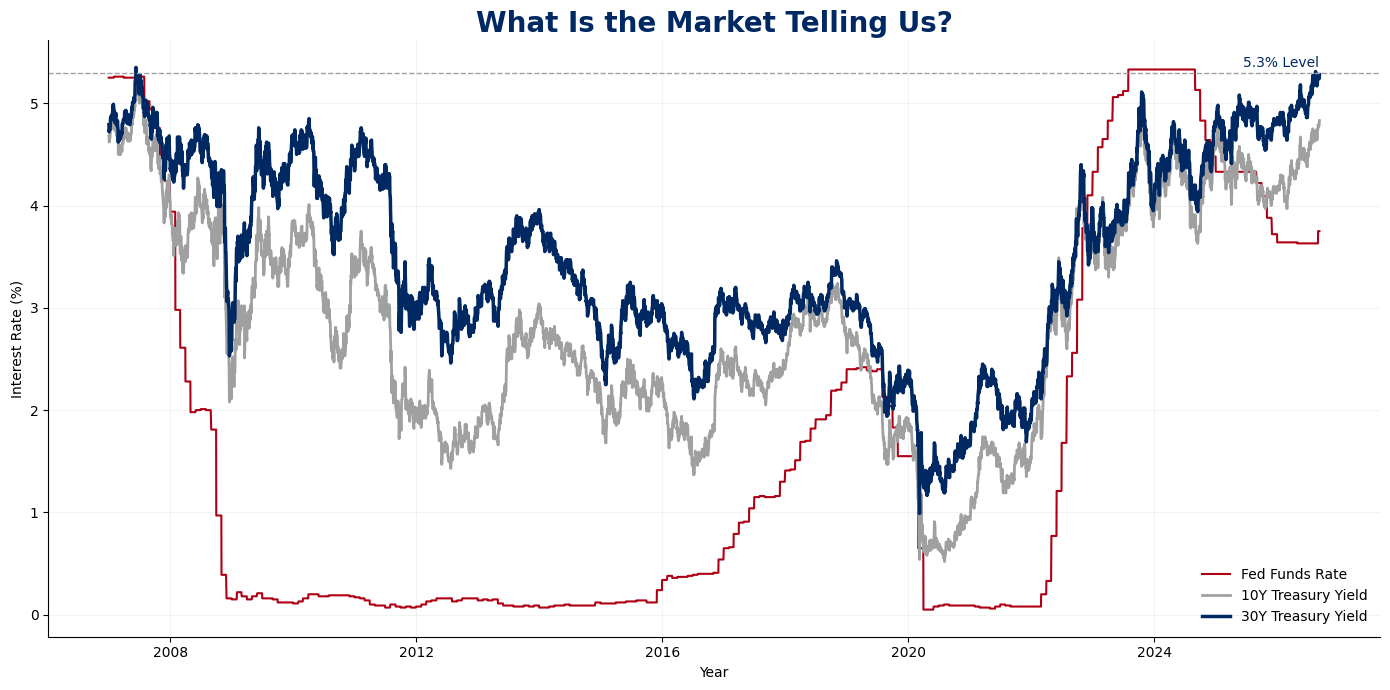 **
Source: Federal Reserve Bank of St. Louis (FRED); Metta Associates Note: Data represent the Federal Funds Rate, 10-Year Treasury Yield, and 30-Year Treasury Yield from 2007–2026.
The Long End Is Telling a Different Story
The Policy Rate remains one of the most important variables in financial markets, particularly for the Short End of the Yield Curve. However, the further investors move along the curve, the more factors become relevant. Long-Term Treasury Yields reflect Expected Future Short-Term Rates, Inflation Expectations, Real Yield, and Term Premium, all of which can move differently from the current Policy Rate.
This helps explain why expectations for lower Policy Rates do not necessarily translate into lower Long-Term Treasury Yields. Long-Term investors are pricing a much longer economic horizon, including where inflation may settle, how much the government will need to borrow, how much Treasury Supply the market must absorb, and what compensation is appropriate for holding long-duration assets.
September provided another clear example of this divergence. Even after the Federal Reserve adjusted the Policy Rate, Long-Term Treasury Yields remained elevated and moved higher toward the end of the month. This suggests that the market was not simply pricing the level of the current Policy Rate, but also the longer-term inflation, fiscal, supply, and real-rate environment.
The reason behind a rise in Long-Term Yields therefore matters as much as the rise itself. If Yields increase because of stronger economic growth and improving Corporate Earnings, the impact may be more manageable because stronger Cash Flows can offset higher Discount Rates. If Yields rise because of Fiscal Risk, Inflation Risk, Treasury Supply, or a higher Term Premium, the effect can be more challenging because the Cost of Capital increases without a corresponding improvement in future Cash Flows.
The Fed’s Influence on the Yield Curve
The Federal Reserve plays a central role in determining financial conditions through Monetary Policy. The Federal Open Market Committee sets the target range for the Federal Funds Rate, which directly influences the Short-Term Cost of Money and has broad effects across credit markets and the economy. When the Federal Reserve raises the Policy Rate, borrowing costs generally increase and financial conditions become more restrictive. When it lowers the Policy Rate, the immediate direction of Short-Term financial conditions generally becomes less restrictive.
The important distinction is that the Federal Reserve does not simply determine the Yield on every Treasury maturity. The 10-Year and 30-Year Treasury Yields are market prices that incorporate expectations for future Monetary Policy, Inflation, Economic Growth, Treasury Supply and Demand, and Term Premium. The Federal Reserve can influence these expectations and therefore influence Long-Term Yields, but it does not directly set their market price.
This distinction became particularly relevant in September 2026. On September 16, the Federal Reserve raised the target range for the Federal Funds Rate by 25 basis points to 3.75%–4.00%, while inflation remained elevated and economic activity continued to expand.
At the same time, Long-Term Treasury Yields did not simply move in line with the Policy Rate. The 30-Year Treasury Yield remained above 5.3% through much of September and reached approximately 5.68% by September 30. The divergence reinforces an important principle: a change in the Federal Funds Rate does not mechanically determine the direction of Long-Term Treasury Yields.
A Federal Reserve Rate Cut can lower the Short-Term Policy Rate while Long-Term Yields remain elevated if investors continue to demand compensation for Inflation Risk, Fiscal Risk, or substantial Treasury issuance. Conversely, a Rate Hike does not necessarily mean that Long-Term Yields must rise by the same amount. If investors believe tighter Monetary Policy will eventually slow Economic Growth and Inflation, the Long End of the curve can respond differently from the Short End.
The relationship between Monetary Policy and Long-Term Yields is therefore not simply about whether the Fed is raising or cutting rates. It is about how the market interprets those actions within the broader economic and Fiscal environment. The Policy Rate is determined by the Federal Reserve, while the Long-Term Cost of Capital is ultimately determined by the market.
From Monetary Policy to Fiscal Reality
For several years, financial markets were dominated by Monetary Policy. Investors closely monitored Federal Reserve meetings, Inflation data, Employment reports, and changes in the expected path of the Policy Rate. That framework remains important, but the growing importance of Government Debt and Fiscal Deficits is changing the way investors need to think about the Treasury market.
The U.S. government must continue to finance its Fiscal Deficit while refinancing existing debt, requiring substantial Treasury issuance over time. Higher Treasury Supply does not automatically mean higher Yields because Investor Demand remains critical. Pension Funds, Insurance Companies, Banks, Asset Managers, Foreign Investors, and other institutional investors all influence the price at which Treasury securities can be absorbed.
The more important question is therefore not simply how much debt the government issues, but what Yield investors require to hold that debt. When investors demand greater compensation to absorb Treasury Supply, the impact can extend beyond Government Bonds into Corporate Borrowing Costs, Mortgage Rates, Equity Valuations, and the broader Cost of Capital. Fiscal Policy therefore becomes not only a government finance issue, but increasingly a market variable.
During the July–September 2026 quarter, the U.S. Treasury estimated approximately $739 billion of privately held net marketable borrowing, highlighting the scale of financing that the market was expected to absorb during the period. The figure illustrates why Treasury Supply remains an important structural consideration for Long-Term Investors rather than simply a short-term market event.
This is where the distinction between Monetary Policy and Fiscal Policy becomes particularly important. The Federal Reserve determines the direction of Short-Term Monetary Conditions, while the Treasury manages Government Financing and the composition of outstanding Government Debt. Long-Term Treasury Yields sit between these forces and are ultimately priced by the market.
Inflation and the Price of Long-Term Uncertainty
For an investor holding a 30-Year Treasury, the concern is not simply whether inflation is high or low today. The investment horizon extends for decades, making the preservation of Purchasing Power and the future Inflation Regime critical considerations. This is why Long-Term Investors focus on Inflation Expectations rather than relying only on the latest CPI reading.
If investors believe inflation will remain structurally higher than it was during the previous decade, they may demand greater compensation for holding long-duration assets. The same applies when uncertainty surrounding Fiscal Policy and Government Debt increases the perceived risk of future inflation. This additional compensation can appear through a higher Term Premium, allowing Long-Term Yields to remain elevated even when Economic Growth moderates or Monetary Policy becomes less restrictive.
Another important component is the Real Yield. Real Yields represent the return investors require after accounting for expected inflation. When Real Yields rise, Long-Term Treasury Yields can increase even without a proportional increase in inflation expectations. This matters because it suggests that higher Long-Term borrowing costs can reflect not only concerns about future inflation, but also a higher required real return for holding long-duration Government Debt.
September provided evidence of this pressure. The 30-Year Treasury real yield was approximately 3.33% at the end of September, showing that a significant portion of the Long-Term Yield environment reflected elevated real borrowing costs rather than inflation expectations alone.
For investors, the distinction between Growth-Driven Yield increases and Inflation- or Fiscal-Driven Yield increases is therefore important. Both can push Treasury Yields higher, but their implications are different. Stronger Growth may support Corporate Earnings and Cash Flows, while higher Fiscal and Inflation Risk can increase the Discount Rate without generating an equivalent improvement in future Earnings.
Treasury Buybacks and Market Liquidity
Treasury Buybacks provide another important part of the current Treasury market discussion. Unlike Monetary Policy, which is conducted by the Federal Reserve, Treasury Buybacks are conducted by the U.S. Department of the Treasury as part of its debt-management activities. Treasury has authority to buy, redeem, or refund outstanding Treasury obligations before maturity, allowing it to manage aspects of the Government's outstanding debt and support the functioning of the Treasury market.
The purpose of Buybacks is therefore different from Federal Reserve asset purchases. Treasury's liquidity-support Buybacks are intended to provide market participants with opportunities to sell less-liquid, off-the-run securities back to the government. This can support secondary-market liquidity and help dealers and other intermediaries manage their inventories and balance-sheet capacity. Treasury can also use Buybacks as part of broader cash and debt-management operations.
The increase in Treasury Buyback operations became more significant in September. Treasury increased the maximum size of liquidity-support Buyback operations for longer-dated nominal coupon securities from $2 billion to at least $4 billion per operation beginning September 9, covering the 10-year-to-20-year and 20-year-to-30-year sectors. Treasury stated that the increase was intended to provide greater liquidity support in longer-dated nominal sectors where it continued to receive strong market participation.
The September increase in Buyback capacity therefore needs to be viewed in this context. The larger operations were designed to provide additional liquidity support in longer-dated Treasury sectors rather than establish a specific level for the 10-Year or 30-Year Yield. Improving market liquidity can make the Treasury market function more efficiently, but it does not remove the underlying forces that determine the price investors require to hold long-duration Government Debt.
This distinction is important because Treasury Buybacks are sometimes interpreted as being similar to Quantitative Easing. Although both involve Treasury securities, they serve different institutional purposes. Federal Reserve purchases operate within a Monetary Policy and reserve-management framework, while Treasury Buybacks operate within a Debt Management and Market Functioning framework. Treasury can influence the composition and liquidity of outstanding debt, but the market continues to determine the Yield required to hold Long-Term Treasury securities.
Why Long-Term Yields Matter for Investors
The importance of Long-Term Treasury Yields extends far beyond the Bond Market. Treasury Yields provide an important reference point for the Risk-Free Rate, which is a fundamental component of Discount Rates used in financial valuation. When Long-Term Yields rise, the required return used to value future Cash Flows can also increase, creating a direct connection between the Treasury market and Equity Valuation.
Businesses whose valuations depend heavily on Cash Flows far into the future can become more sensitive to higher Discount Rates. Companies trading at high Valuation Multiples may also face greater pressure because a higher Cost of Capital reduces the present value investors are willing to assign to future growth. The impact, however, is not uniform across companies.
Businesses with strong Free Cash Flow, High Return on Capital, efficient Capital Allocation, manageable leverage, and strong Balance Sheets may be better positioned in a higher Cost of Capital environment. Growth remains important, but investors increasingly need to consider how much capital is required to achieve that growth, what Return on Capital the business generates, and whether growth can ultimately translate into sustainable Free Cash Flow.
This is why the Long-Term Treasury market matters even to investors who do not own Government Bonds directly. Changes in Long-Term Yields can affect the valuation framework used across Equities, Corporate Bonds, Real Estate, and other long-duration assets. The Long-Term Cost of Capital is therefore becoming an increasingly important variable in Portfolio Construction.
Key Takeaways
- The Federal Reserve influences Short-Term Interest Rates, but Long-Term Treasury Yields remain market-determined. Expectations for Growth, Inflation, Treasury Supply and Demand, and Term Premium all influence the Long End.
- September reinforced the divergence between the Policy Rate and the Long End. The Federal Reserve raised the Federal Funds Rate to 3.75%–4.00%, while the 30-Year Treasury Yield remained elevated and reached approximately 5.68% by September 30.
- Fed Rate changes do not automatically determine Long-Term Yields. Fiscal Conditions, Treasury Supply, Inflation Expectations, Real Yields, and Term Premium can keep the Long-Term Cost of Capital elevated.
- The Federal Reserve and Treasury have different institutional roles. The Fed conducts Monetary Policy, while Treasury manages Government Financing and Outstanding Debt.
- Treasury Buybacks primarily support liquidity and debt management. The increase in longer-end Buyback sizes beginning September 9 should not be viewed as a mechanism for directly controlling Long-Term Treasury Yields.
- Higher Long-Term Yields increase the importance of fundamental analysis. Free Cash Flow, Return on Capital, Capital Efficiency, Balance Sheet Strength, and Valuation become increasingly important.
Metta Associates's Strategic Reflection
The recent behavior of the Treasury market reinforces an important point for investors: Monetary Policy is only one part of the broader Cost of Capital equation. The Federal Reserve remains critical for Short-Term Interest Rates and financial conditions, but the behavior of the Long End shows that investors are also pricing Fiscal Policy, Government Debt, Treasury Supply, Inflation Expectations, Real Yields, and Term Premium into Long-Term Assets.
September 2026 provided a particularly clear illustration of this dynamic. The Federal Reserve raised the Policy Rate by 25 basis points to 3.75%–4.00%, yet the Long End remained elevated and the 30-Year Treasury Yield reached approximately 5.68% by the end of the month. This divergence demonstrates why investors cannot assess the Long-Term Cost of Capital solely through the expected path of the Federal Funds Rate.
For Metta Associates, this means that the investment discussion should move beyond simply predicting the next Federal Reserve decision. The more important consideration is how the Long-Term Cost of Capital is changing and what that change means for Businesses, Asset Valuations, and Portfolio Construction. A higher Long-Term Yield does not automatically imply a single investment response; its implications depend on whether the increase is driven by stronger Growth, persistent Inflation, Fiscal Risk, Treasury Supply, Real Yields, or changes in the Term Premium.
Metta therefore emphasizes Diversification, Valuation, Cash Flow, Return on Capital, Capital Efficiency, and Balance Sheet Strength, while continuously monitoring the interaction between Growth, Inflation, Interest Rates, and Fiscal Risk. The objective is not to predict every movement in the Fed Funds Rate or Treasury Yield, but to build portfolios that can remain resilient as the Long-Term Cost of Capital and market regime evolve.—always with you.
Disclaimer
The information presented is based on sources believed to be reliable; however, its accuracy or completeness cannot be guaranteed. This material does not represent a forecast and should not be interpreted as a guarantee of future outcomes. It has been prepared with care and objectivity to support long-term, planning-focused financial decisions.