
Beyond the Midterms: Why Investment Discipline Matters More Than Political Predictions
Beyond the Midterms: Why Investment Discipline Matters More Than Political Predictions
The November 2026 U.S. midterm elections have brought a significant shift in Washington. Democrats have secured control of both the House of Representatives and the Senate, ending Republican control of Congress while President Donald Trump remains in the White House. The result sets the stage for a period of divided government beginning in January 2027, with potentially important implications for legislation, public spending, and economic policy.
For investors, changes in political leadership often introduce a familiar sense of uncertainty. Questions naturally arise about whether legislative gridlock will weaken economic growth, whether disagreements over government funding could trigger another shutdown, and whether financial markets will respond negatively to the change in political control.
These concerns are understandable. Yet the relationship between politics and investment performance is rarely as straightforward as the headlines suggest. Markets are influenced by a wide range of interconnected factors, including corporate earnings, inflation, interest rates, economic growth, and investor expectations. Political developments can affect these variables, but an election result alone does not determine the direction of financial markets.
The more useful question, therefore, is not simply what happens when political power changes hands, but what historical evidence tells us about the relationship between political control, market volatility, and subsequent investment performance.
What Divided Government Actually Means
To understand the election's implications, it helps to first understand how the U.S. government works.
Unlike in some countries, the U.S. president and Congress are elected separately. Congress consists of two chambers: the House of Representatives and the Senate. Both must approve a proposed law before it is sent to the president for approval.
Following the 2026 midterm elections, Democrats will control both chambers of Congress, while Republican President Donald Trump remains in office. This arrangement is known as divided government, where the president and Congress are controlled by opposing political parties.
However, controlling Congress does not give Democrats unlimited power. President Trump can still reject proposed legislation through a presidential veto. Congress can override that veto, but doing so generally requires a two-thirds majority in both chambers, a threshold that has historically been difficult to achieve.
Likewise, the president cannot simply pass new laws without Congress. Democrats can block legislative proposals, influence government spending, and oversee the administration, while the president retains executive authority under existing laws.
As a result, a divided government often requires greater negotiation and compromise. When both parties cannot agree, major legislation may be delayed or blocked altogether. Disagreements over federal spending can also lead to government shutdowns, although divided government does not necessarily mean a shutdown will occur.
When Political Gridlock Leads to a Government Shutdown
One consequence of political disagreement in Washington is the possibility of a government shutdown.
In the United States, Congress must approve federal funding, which generally also requires the president's signature. If both sides cannot agree on a budget or temporary funding extension before existing funding expires, some government agencies must suspend their operations.
This does not mean the entire government stops functioning. Essential services may continue, but some federal employees are temporarily sent home, public services are disrupted, and important economic reports may be delayed.
For example, the government-wide shutdown in October–November 2025 lasted 42 full days, delaying employment reports and preventing the release of the usual October unemployment estimates. More recently, a separate shutdown affecting the Department of Homeland Security lasted 75 days between February and April 2026.
Despite these disruptions, government shutdowns have not historically produced a consistent negative reaction in the stock market. The S&P 500 has risen during some shutdowns and declined during others.
This does not mean shutdowns are without economic consequences. Rather, it highlights an important distinction: political uncertainty does not necessarily translate into market losses. Stock-market performance ultimately depends on a broader combination of economic conditions, corporate earnings, interest rates, and investor expectations.
What History Tells Us About Midterm Elections and Market Performance
To examine the relationship between political outcomes and market performance, Metta Associates analyzed the S&P 500 across 19 U.S. midterm elections from 1950 to 2022, focusing on the 12 months following each election.
The findings are notable. All 19 historical periods recorded positive 12-month nominal price returns, with a median of 14.5%. While this challenges the assumption that political changes necessarily lead to market declines, it does not guarantee similar outcomes following the 2026 election. Historical returns also reflect broader economic conditions rather than election results alone.
Does the Party in Power Make a Difference?
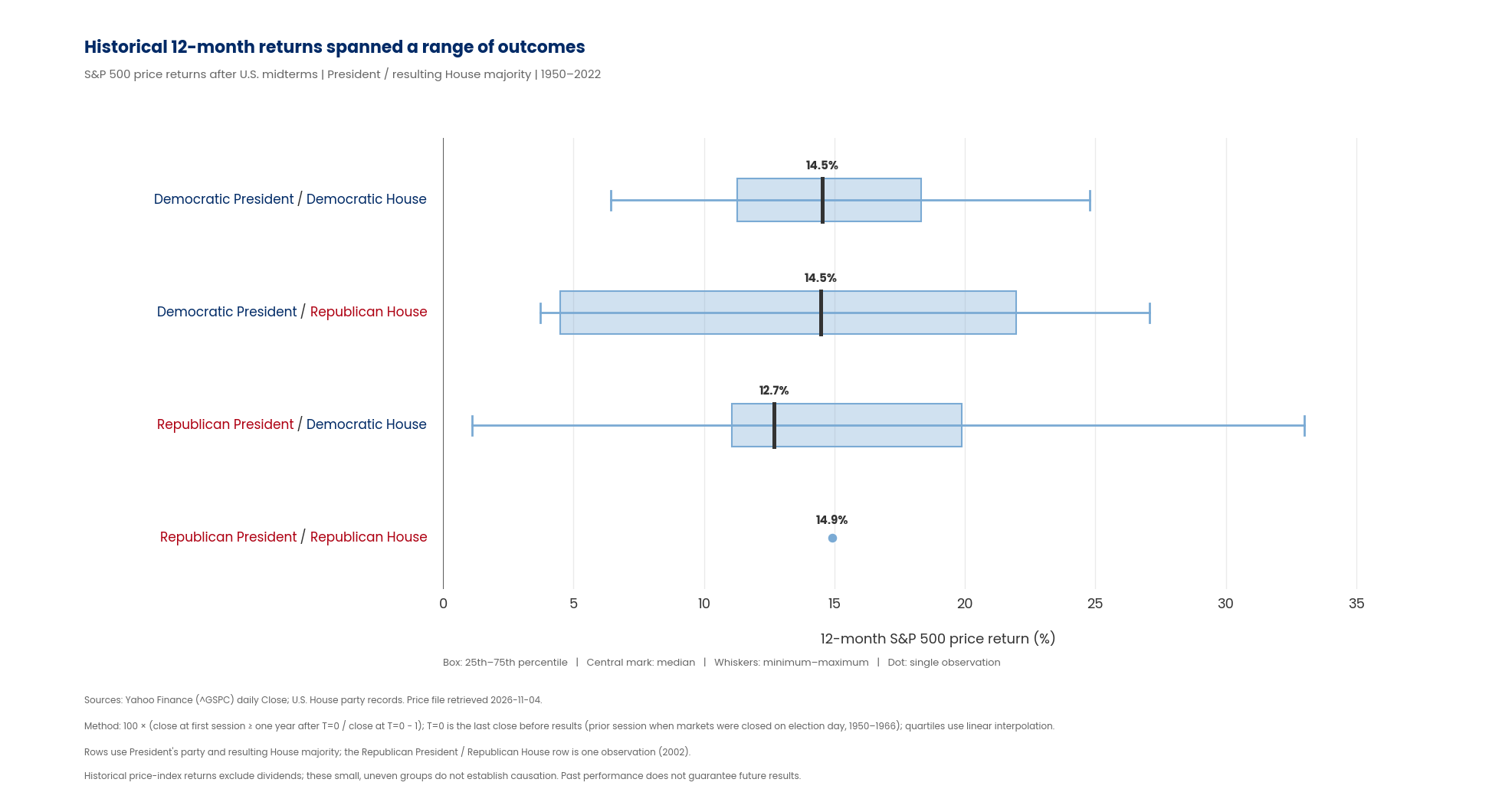
Chart caption: Distribution of 12-month S&P 500 price returns following 19 midterm elections (1950–2022), grouped by the president's party and incoming House majority. The Republican–Republican configuration contains only one observation. Source: Metta Associates quantitative research.
Despite differences in political control, historical median returns were relatively similar across the four configurations. Notably, under a Republican president and Democratic House, the arrangement relevant to 2026, all nine historical observations produced positive 12-month returns, with a median of 12.7%.
However, these outcomes do not establish that any particular political configuration is inherently better for investors. Differences in market performance were not sufficiently consistent to make political control a reliable investment signal, particularly given the limited sample sizes and varying economic conditions.
Market Volatility Around Midterm Elections
Positive returns do not necessarily mean a smooth investment journey. Although all 19 historical periods finished higher after 12 months, 11 experienced an interim peak-to-trough decline of at least 10%, demonstrating that meaningful volatility can occur even when longer-term outcomes are favorable.
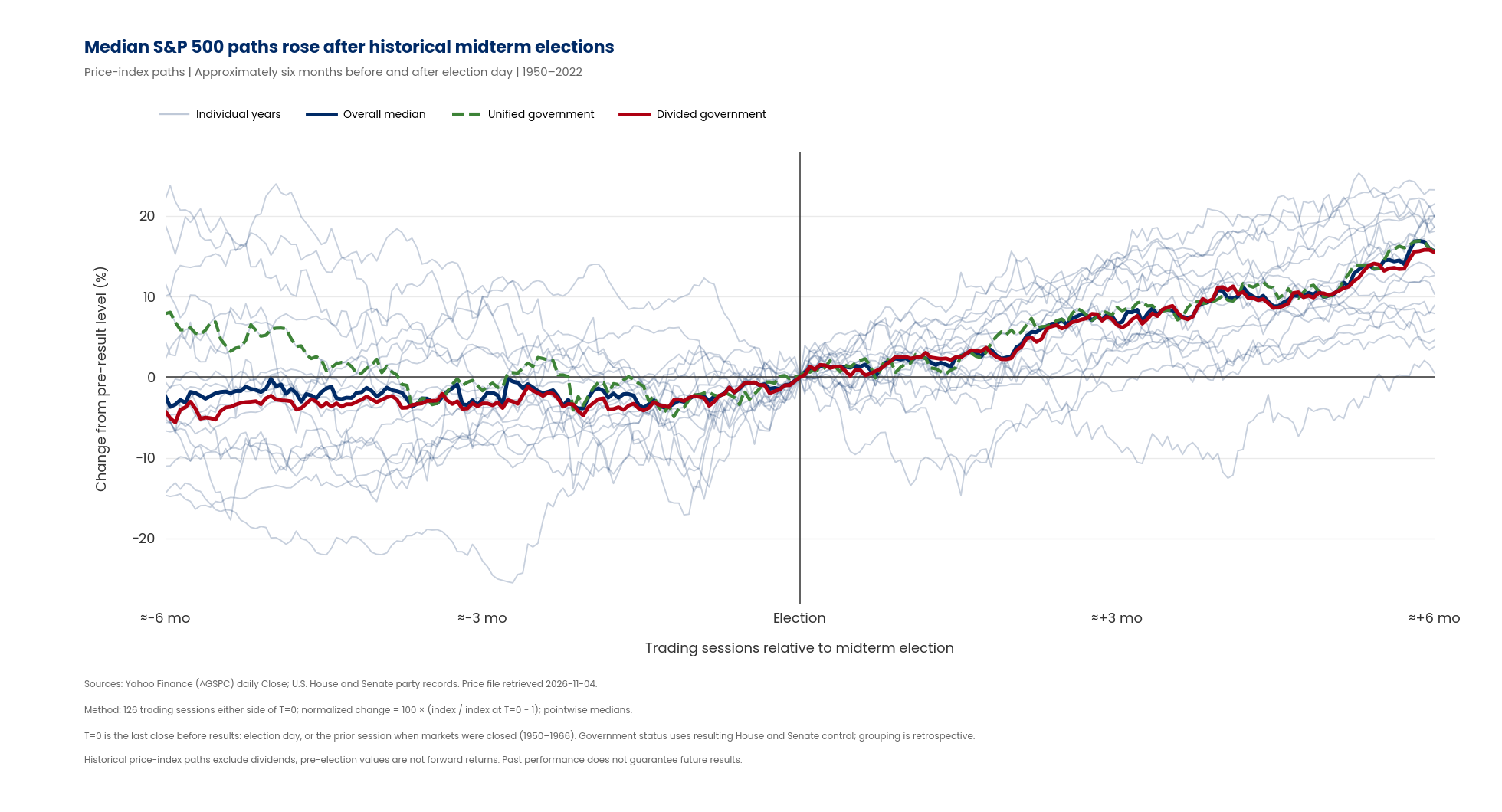
Chart caption: Historical S&P 500 market paths across 19 midterm elections, approximately six months before and after each election, normalized to 0% at the election-date reference close. Lines show individual observations and the medians for all elections, unified government, and divided government. Source: Metta Associates quantitative research.
Comparing unified and divided government also reveals no statistically reliable difference in subsequent 12-month returns, with historical medians of 14.9% and 13.6%, respectively.
Interestingly, realized volatility more often declined than increased following midterm elections. However, similar patterns were observed outside election periods, suggesting that broader market conditions and seasonal factors may also contribute.
The central lesson is that political outcomes alone offer limited guidance for investment decisions. Markets respond to economic fundamentals, corporate earnings, interest rates, and changing expectations—not simply which party controls Washington.
Key Takeaways
- Political change does not necessarily mean market decline. Historical evidence shows no consistent relationship between political control and stock-market performance.
- Positive returns do not eliminate risk. All 19 historical midterms were followed by positive 12-month returns, yet 11 experienced drawdowns of at least 10%.
- Historical evidence informs, but does not predict. Market performance depends on economic fundamentals and broader financial conditions, not election outcomes alone.
- Investment discipline matters more than political predictions. Appropriate asset allocation, diversification, and long-term financial objectives should guide decisions rather than short-term political noise.
Metta's Strategic Reflection
Elections may change who holds power in Washington, but they do not change the financial objectives that matter to investors. A family's retirement, a child's education, or the need to preserve wealth should not be dictated by the latest political headlines. The purpose of capital should remain the foundation of every investment decision, regardless of market sentiment.
Historical evidence reminds us that anticipating political outcomes is not the same as predicting market performance. Attempting to avoid uncertainty through frequent trading requires investors to correctly time both their exit and re-entry. Greater activity may create the appearance of sophistication, but it does not necessarily produce better results.
At Metta Associates, we believe successful wealth management is not measured by how often a portfolio is adjusted or how many market opportunities are captured, but by its ability to support the objectives for which the wealth was built. This is why we prioritize thoughtful asset allocation, sufficient liquidity, and disciplined risk management, ensuring that investment decisions reflect each client's financial needs and time horizon.
Markets will remain unpredictable, and political uncertainty will never disappear. Our responsibility is not to eliminate uncertainty, but to help clients navigate it with clarity, evidence, and discipline. Ultimately, returns are a means to achieving financial objectives, not the objective itself. That principle remains at the heart of our commitment to long-term financial stewardship —always with you.
Disclaimer
The information presented is based on sources believed to be reliable; however, its accuracy or completeness cannot be guaranteed. This material does not represent a forecast and should not be interpreted as a guarantee of future outcomes. It has been prepared with care and objectivity to support long-term, planning-focused financial decisions.