Investing vs. Trading—Knowing the Difference, Protecting Your Future
Behavioral finance consistently shows that inconsistency is one of the most damaging habits in personal finance. Many begin as investors, but when markets decline, panic takes over. Without realizing it, they start acting like traders—not by strategy, but by accident. The result is the worst of both worlds: carrying the risks of each approach without gaining the protection of either.
The cost of this behavioral drift is measurable. In 2023, the average equity fund investor underperformed the S&P 500 by 5.5%—the third-largest gap in the past decade. Fixed-income investors also lagged behind their benchmark by 2.63%. What drove these gaps? Emotional decisions: selling during downturns, hesitating to reinvest, and missing the rebound. Even in strong market years, these reactions quietly erode returns and can derail a carefully constructed financial plan.
The first step to protecting your plan is to distinguish between two approaches that are often mistaken for one another—investing and trading.
Investing Asks ‘What’s It Worth?’ — Trading Asks ‘What’s It Priced At?’
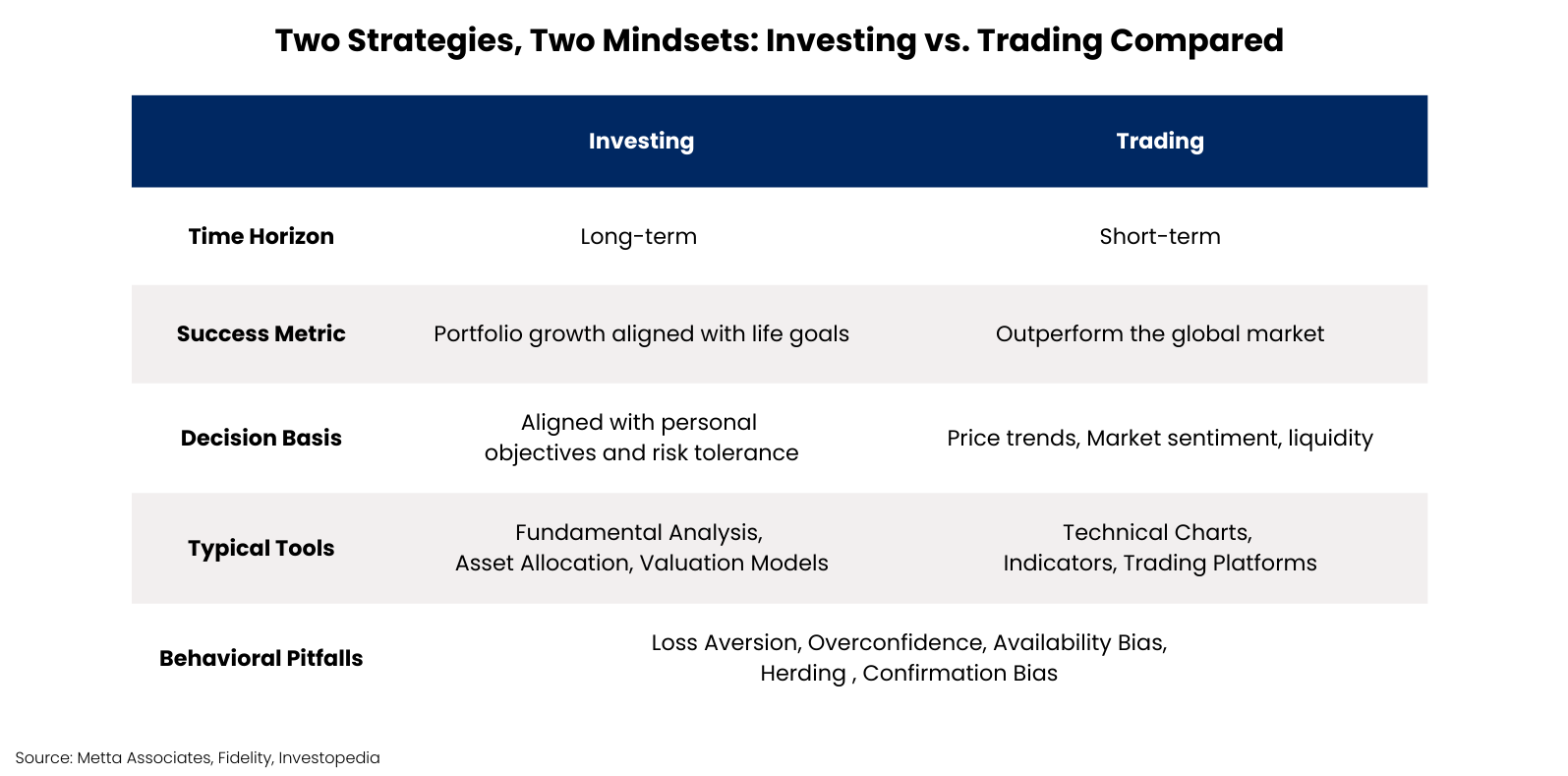
Investing begins with one question:
What is this asset worth,
based on its ability to generate future cash flows?
It’s rooted in valuation—the present value of expected earnings, discounted for time and risk. Whether it’s individual stock, a global ETF, or a business, the decision is grounded in what the asset can deliver under reasonable long-term assumptions.
Trading, on the other hand, is a different question entirely:
What will someone else pay for this tomorrow?
It’s about price momentum, liquidity, and short-term sentiment. Traders don’t rely on intrinsic value—they rely on predicting what others will do next. It can be profitable, but it demands a fundamentally different mindset.
Why This Distinction Matters in Wealth Management
As stewards of multi-decade plans, we cannot afford confusion. Investing serves your core financial objectives. It is valuation-based and planning-aligned. Trading—when misunderstood or misapplied—can disrupt your overall financial strategy.
Investing: Start with Purpose, End with Clarity
Think about your financial goals—whether they are near-term objectives like buying a home, or long-term aspirations such as retiring comfortably or leaving a legacy for your family. Be honest about your comfort with risk and how much cash you need on hand for life’s surprises. Once you have clarity, choose investments that match these goals rather than chasing trends or reacting to headlines.
After you’ve started investing, your most powerful tool is patience. Check in on your portfolio every six months or once a year, and use these moments to reflect, not react. When markets swing wildly, remind yourself why you invested in the first place. Staying calm and consistent helps you avoid the emotional mistakes that can quietly chip away at your future wealth.
Trading: Begin with Rules, Stay with Discipline
Before you begin Trading, define specific rules and limits. Decide how much money you’re willing to risk, the time frame for each position, and the exact levels where you will take profits or cut losses. Separate your trading funds from your core investment portfolio to prevent confusion and protect your capital.
After each trade, record the outcome and compare it to your plan. Analyze what worked, what didn’t, and adjust your approach based on facts—not feelings. Keep trading decisions strictly disciplined, and never allow losses to push you into impulsive actions.
By treating investing as a steady, purpose-driven process and trading as a precise, rule-based activity, you create balance. This separation gives you both growth and flexibility—without letting emotional reactions disrupt your overall financial strategy.
When Behavior Breaks Strategy
In today’s financial environment, the biggest threat isn’t always the market itself—it’s our own behavior within it. With digital platforms and constant news cycles pushing for quick reactions, many are tempted to trade on impulse, mistaking action for progress. The thrill of doing something often overshadows the wisdom of staying the course.
Recognizing the difference is more than a reflection exercise; it’s the first defense against inconsistency. By aligning your behavior with your true role, you protect your strategy from emotional detours and keep your financial plan on track.
Key Takeaways:
Investing and Trading Require Different Mindsets Investing focuses on understanding fundamental value and disciplined decision-making; trading focuses on capturing opportunities driven by price movements and market dynamics. Confusing the two leads to inconsistent decisions and higher risk.
Clarity in Financial Identity Protects Discipline Acting like a trader while maintaining an investor's mindset often leads to buying high, selling low, or exiting during periods of stress. Anchoring behavior to a long-term investor mindset helps avoid emotional mistakes.
Dividing Funds for Financial Stability To maintain a strong financial plan, a clear line must be drawn between the main investment portfolio and the funds used for active trading, thereby protecting long-term capital from high-risk losses, simplifying performance tracking, and maintaining emotional discipline during market volatility.
Sources: Fidelity, Investopedia, Dimensional Fund Advisors, CFA Institute, Ilmanen (2011), DALBAR
Metta Associates's Strategic Reflection
At Metta Associates, clarity is not a luxury but a foundation for long-term success. In markets that reward speed and constant reaction, we keep clients focused on purpose so that every decision reflects the plan rather than pressure. The distinction between investing and trading is not merely technical; it shapes behavior under uncertainty and, if blurred, leads to inconsistent choices and avoidable risk.
Clarity protects more than capital. It preserves the integrity of the plan, supports sound decision-making, and strengthens confidence when conditions are difficult. When we employ tactics such as rebalancing or short tactical windows, they serve the plan with intention, not impulse.
We anchor every relationship in a simple truth: you are an investor with a well-defined strategy, not a reactor to short-term noise. Through clear communication, rational expectations, and disciplined frameworks, we guide decisions rather than chase markets.
Always with You.
Disclaimer
This content is intended for general informational purposes only and does not constitute investment advice, a recommendation, or an offer to buy or sell any financial instruments. It does not consider your specific investment objectives, financial situation, or needs. You are encouraged to consult a licensed financial advisor before making any financial decisions.
The information presented is based on sources believed to be reliable; however, its accuracy or completeness cannot be guaranteed. This material does not represent a forecast and should not be interpreted as a guarantee of future outcomes. It has been prepared with care and objectivity to support long-term, planning-focused financial decisions.